


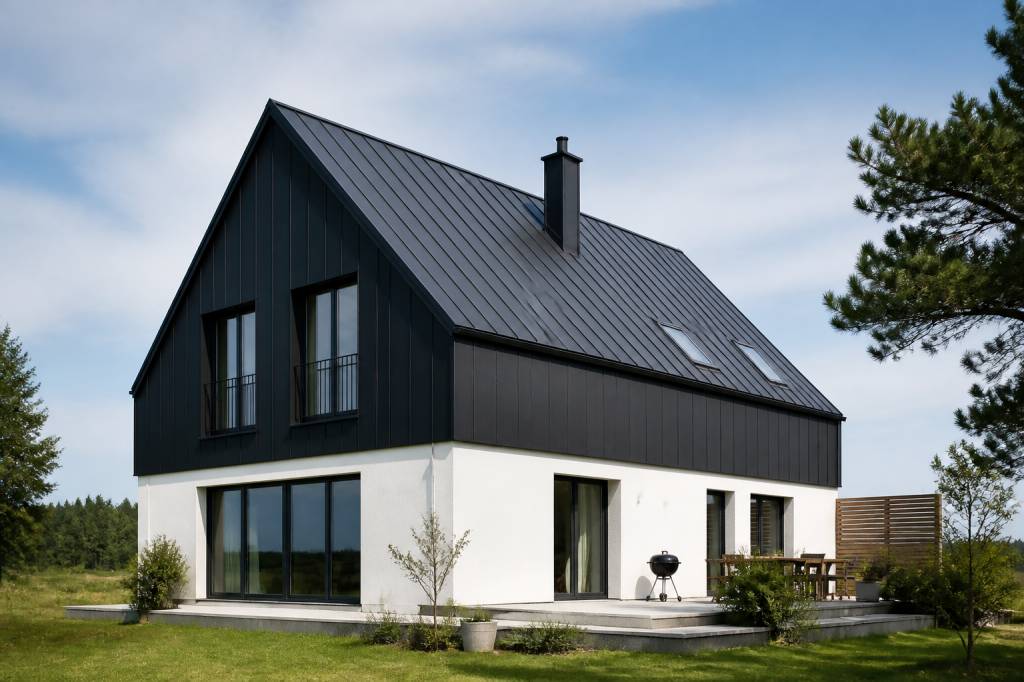
What a 16/12 roof pitch actually means
A 16/12 pitch roof is steep. Very steep. For every 12 inches of horizontal run, the roof rises 16 inches. In plain English, the roof angle is roughly 53 degrees, which places it well above the slope you see on most suburban homes.
That steepness is not just a visual detail. It affects everything: the roofline, drainage, structural loads, attic volume, material choice, maintenance, and even how the house reads from the street. If you are aiming for a modern home with strong architectural character, a 16/12 roof can be a powerful design move. If you are not careful, it can also become an expensive one.
The key question is not “does it look good?” It is “does it work for the house, the climate, and the budget?” That is where planning matters.
Why homeowners choose this pitch
There is a reason steep roofs keep coming back in contemporary architecture. They do more than nod to tradition. They solve practical problems.
A 16/12 pitch is often chosen when the project needs one or more of the following:
- Fast water and snow shedding in wet or cold climates
- More usable volume under the roof for loft storage or a habitable attic
- Stronger visual presence from the street
- Compatibility with gable forms, chalet-inspired modern homes, or angular additions
- Better performance for certain roofing materials, especially some shingles and standing seam metal systems
In a recent renovation I reviewed, the owners had been torn between a low-slope roof for a sleek look and a steep roof for practical reasons. Their site sat under heavy winter rain and occasional snow. The architect finally pushed for the steep option, not because it was “trendier,” but because the roof would stay drier, shed debris faster, and create space for an upstairs office without expanding the footprint. That was a smart trade-off.
What makes a 16/12 pitch different from more common slopes
Most modern homes do not use a roof this steep. You will more often see 4/12, 6/12, or 8/12 pitches, especially in contemporary and minimalist projects. At 16/12, you are moving into steep-roof territory, which changes the construction logic.
Compared with a lower pitch, a 16/12 roof generally means:
- More framing lumber and more complex scaffolding access
- Higher labor costs because installation is slower and riskier
- Greater material waste due to cuts and layout complexity
- Potentially larger attic space or cathedral ceiling opportunities
- Higher wind exposure on some elevations, depending on the site
It also changes the way the roof looks. Lower pitches tend to read as horizontal and calm. A 16/12 roof introduces stronger verticality. Used well, that can give a modern home a crisp, sculptural profile. Used badly, it can look like someone simply made the roof too tall because they ran out of ideas.
Best modern house styles for a 16/12 pitch
This pitch is not for every design. It shines in certain architectural languages and looks awkward in others.
It works particularly well for:
- Modern farmhouse designs with simplified gables
- Contemporary chalet or mountain homes
- Scandinavian-inspired homes with clean lines and strong roof silhouettes
- Black-clad or timber-clad homes where the roof is part of the overall composition
- Hybrid designs mixing traditional massing with modern glazing
It is less successful when paired with very flat, boxy façades that depend on strict horizontal lines. If your home is all about restrained minimalism, this pitch can dominate the elevation and fight against the design intent.
A useful rule of thumb: the steeper the roof, the more intentional the rest of the architecture has to be. Windows, cladding breaks, eaves, and proportions need to be resolved properly. Otherwise the roof steals the show, and not in a good way.
Structural implications you cannot ignore
Before anyone falls in love with the silhouette, the structure needs a proper check. A 16/12 roof is not simply a matter of “adding more angle.” It changes how the whole roof system behaves.
Points to review with your architect or structural engineer:
- Rafter sizing and span limits
- Connection details at ridge, wall plate, and roof-to-wall junctions
- Wind uplift resistance, especially in exposed areas
- Snow load requirements where applicable
- Whether trusses, stick framing, or a hybrid system is most efficient
On a steep roof, forces are not the same as on a low-slope one. Access and safety become more difficult too, which affects both the build and long-term maintenance. You do not want to discover halfway through the project that your chosen roofing contractor is nervous on steep pitches. That is not the moment to start shopping around.
Roofing materials that suit a steep pitch
Material choice matters more on a steep roof than many people expect. Some coverings perform better on steep slopes, and others become unnecessarily expensive without adding much benefit.
Good options often include:
- Architectural asphalt shingles, if the budget is controlled and the detailing is solid
- Standing seam metal roofing, for a clean modern look and excellent durability
- Slate, where budget and structure allow it
- Fiber cement or composite slates, as a lower-weight alternative
- Wood shingles or shakes, where local codes and maintenance expectations allow them
For a modern home, standing seam metal is often the most convincing choice. It complements the geometry, looks sharp on steep planes, and handles weather well. It is not cheap, though. Expect a higher upfront cost than standard shingles, especially if your roof has multiple valleys, dormers, or awkward junctions.
Typical budget ranges vary wildly by region, but as a practical planning guide:
- Basic asphalt roofing: lower upfront cost, shorter lifespan
- Standing seam metal: mid to high cost, strong longevity
- Slate or premium composites: high cost, premium appearance, more structural demands
If you are comparing quotes, ask contractors to separate material, labor, scaffolding, underlayment, flashing, and waste disposal. Otherwise the numbers are too vague to be useful.
Drainage, weather protection, and the hidden details
Steep roofs are often praised for water runoff, but that does not mean the waterproofing details can be casual. In fact, because the roof moves water quickly, every flashing, valley, and edge condition becomes more important.
Watch these details carefully:
- Underlayment specification for your climate
- Ice and water shield in vulnerable areas
- Flashing at chimneys, dormers, and wall intersections
- Gutter sizing and downspout placement
- Snow guards if sliding snow could threaten entrances or landscaping
If your roof is steep enough, you may also need to think about where water lands. A high-performing roof is not only about keeping water out. It is also about moving water away from foundations, paths, and planting beds without creating splashback or erosion. This is the sort of detail that gets ignored until the first heavy storm, which is usually a poor moment for a lesson.
What it means for attic space and interior design
One of the hidden advantages of a 16/12 pitch is volume. A steep roof creates a more generous roof cavity, which can be a major benefit in modern homes where every square metre counts.
That extra volume can be used for:
- A vaulted ceiling in the main living area
- A loft bedroom or study
- Storage in the roof space
- Skylights or roof windows with better proportions
- More interesting ceiling lines in an otherwise simple plan
But be realistic. Creating usable interior space under a steep roof is not as easy as drawing a triangle on paper. You still need insulation depth, ventilation strategy, structural clearance, and practical circulation. Dormers can help, but they add cost and complexity. Open ceilings look beautiful, but they can also expose the realities of thermal performance, acoustic issues, and the occasional awkward beam.
If your goal is a bright, airy modern interior, a steep roof can help dramatically. Just make sure the insulation and air tightness strategy is designed from the start, not improvised later.
Planning permission, codes, and local restrictions
Before committing to a 16/12 roof, check the local planning context. In some areas, the height, slope, and massing of the roof may be tightly controlled. In others, the main constraint is simply whether the structure meets code.
Things to verify early:
- Maximum ridge height allowed on your site
- Setback rules that affect roof massing
- Planning review for visible roof form in protected or historic areas
- Fire rating requirements for roofing materials
- Local snow, wind, and seismic design rules
Do not assume that because the roof is technically possible, it is automatically acceptable. I have seen projects where the roof design had to be revised twice because the ridge height exceeded local limits once insulation build-up and ceiling structure were properly accounted for. Paper plans are forgiving. Building inspectors are not.
Cost factors and where the money goes
A 16/12 pitch roof usually costs more than a gentler slope. The main reasons are straightforward: more labor, more safety measures, and more material handling.
Your budget should account for:
- Framing complexity and labor hours
- Scaffolding or roof access equipment
- Premium underlayments and flashings
- Roof covering costs
- Gutters, fascia, soffits, and edge detailing
- Potential interior finishes if you are converting attic volume
If you are trying to control costs, the biggest savings usually come from simplifying the roof geometry, not from downgrading critical waterproofing. A straightforward gable with clean detailing will always be more economical than a steep roof chopped up by too many valleys and dormers.
Design tips for getting the modern look right
A steep roof can look contemporary, but only if the rest of the design supports it. Here are the moves that usually work best.
First, keep the massing clean. Simple forms are your friend. A strong roof silhouette paired with a cluttered elevation just feels overworked.
Second, choose materials deliberately. Dark metal roofing, smooth render, vertical timber, charred wood, or fiber cement panels often suit this roofline better than overly decorative finishes.
Third, pay attention to openings. Windows should feel placed, not scattered. Large glazed areas can balance the weight of a steep roof, especially on the ground floor.
Fourth, control the eaves. Deep eaves can add character and protection, but they should be proportioned carefully. Too shallow, and the roof looks abrupt. Too deep, and the house starts to look less modern and more like it is trying to shelter a small village.
Questions to ask before you build
If you are thinking about a 16/12 roof for your home, ask these questions before moving ahead:
- Does the steep pitch solve a real problem, or just create a visual effect?
- Will the roof volume be used, or will it be wasted space?
- Is the structural system suited to a steep slope?
- Which roofing material gives the best balance of cost, durability, and appearance?
- How will maintenance be done safely in five or ten years?
- Does the roof comply with local planning and code requirements?
If you cannot answer those clearly, slow down. Roofs are not where you want guesswork. They are too expensive to fake.
A practical way to decide if it is right for your home
The best roof design is the one that aligns architecture, climate, structure, and budget. A 16/12 pitch is excellent when you need a steep, expressive roof that performs well in weather and adds usable volume. It is less suitable when the priority is a low, horizontal, ultra-minimal profile or when the budget is already stretched thin.
A simple decision filter helps:
- If your site gets heavy rain or snow, this pitch is worth considering.
- If you want attic volume or vaulted interiors, it can be a smart choice.
- If your budget is tight, simplify the roof form first.
- If your home must stay visually low and restrained, explore gentler slopes.
Handled properly, a 16/12 pitch roof can give a modern home real character without sacrificing performance. The trick is not falling in love with the angle before checking the details. That is how projects drift into expensive drama. Better to do the unglamorous work first: compare quotes, review drawings, check the structure, and choose materials that suit the slope. The roof will thank you for it for decades.