


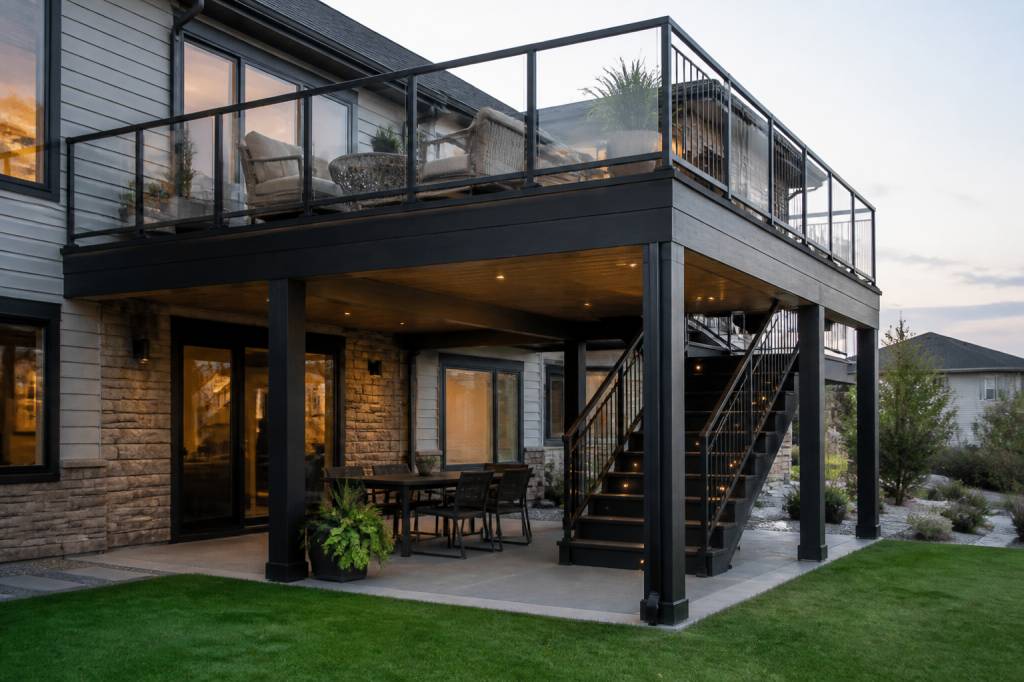
A two-storey deck can do more than add outdoor square footage. Done well, it gives a modern home a clearer relationship with the garden, creates distinct zones for dining and relaxing, and makes an elevated rear facade feel intentional rather than awkward. Done badly, it becomes an expensive platform with a railing and a lot of regret.
If you are considering a two-level deck for a contemporary home, the key is not to think “bigger”. Think “better organised”. The strongest designs use height changes to solve real problems: a back door that sits high above the garden, a compact plot that needs separate functions, or a home with a strong horizontal architectural language that benefits from clean, layered outdoor lines.
Below are two practical deck ideas that suit modern homes, with notes on materials, proportions, budget, and the details people often forget until the builder starts asking questions.
Why a two-storey deck works so well on modern homes
Modern architecture tends to favour crisp geometry, large openings, and a direct connection between inside and outside. A two-level deck supports that language beautifully. Instead of one flat terrace trying to do everything, you can create a sequence: one level for movement and transition, another for lounging, dining, or soaking up sun.
This approach is especially useful if your house sits above the garden, which is common in homes with a raised ground floor, basement, sloping site, or rear extension. Rather than fighting the level change, the deck uses it.
There are also practical benefits:
The caveat? A two-storey deck is not a casual weekend DIY project unless you are highly experienced. Structural loads, waterproofing, drainage, balustrades, and stair geometry all need to be handled properly. This is a “measure twice, build once” situation. Preferably with a structural engineer involved.
Idea one: a floating upper deck with a lower lounge platform
This is one of the most effective layouts for modern homes. The upper level sits directly off the house, usually at interior floor level or just below it, and acts as the main circulation and dining space. A few steps down, the lower level becomes a more relaxed lounge area, outdoor kitchen, or fire pit zone.
The visual effect is clean and contemporary. The upper deck extends the house, while the lower deck feels slightly more private and grounded in the garden. It also creates a natural hierarchy: the top level is the “inside-out” space, the lower level is the “garden room”.
I worked on a scheme where a new rear extension opened onto a raised terrace only 1.2 metres above garden level. The clients originally wanted one large deck spanning the whole width of the house. It would have worked, technically, but it would also have looked flat and overbuilt. We split it into two platforms instead. The upper level handled dining and circulation; the lower level held a built-in bench and planters. The garden suddenly felt larger, not smaller, because the levels gave the eye a reason to move.
That is the trick: levels can make a small garden feel more considered, not more cramped.
How to plan the layout
Start with the way people will actually use the space. Not the mood board version of your life. The real version, with muddy shoes, barbecue trays, and someone carrying a bowl of salad while avoiding a child on a scooter.
A sensible upper/lower deck arrangement usually follows this logic:
Keep the upper deck slightly deeper than the minimum needed for circulation. If you want a table for six, allow space to pull chairs out properly. As a rule of thumb, a dining area needs more room than people think. Tight decks look stylish in photos and irritating in real life.
For the lower platform, avoid making it too narrow. If it is just a landing with no real function, it will feel like wasted construction. Give it a job: seating, planting, a daybed, or a discreet hot tub if the structure is designed for it.
Materials that suit the modern look
The best materials for contemporary decks are usually the ones that are consistent, durable, and visually quiet. You want the architecture to lead, not the decking profile.
Good options include:
For modern homes, colour matters as much as material. Mid-tone greys, charcoal, and weathered timber usually sit well against rendered facades, black-framed glazing, and brickwork. Avoid overly orange timber tones unless that contrast is intentional and balanced by other warm materials.
Also think about board direction. Running boards in the same direction as the house or extension can reinforce length and calmness. Running them across the width can make a terrace feel broader. There is no universal rule; test the effect with a sketch or site plan before committing.
Lighting, privacy, and safety: the unglamorous details that make the design work
Decks are often judged by how they look at sunset, which is exactly why lighting should be planned before the first fix, not after the electrician has gone home.
A modern two-storey deck benefits from layers of light:
Keep it subtle. Overlighting a deck is the outdoor equivalent of wearing sunglasses indoors. It defeats the point.
Privacy is another issue. A raised lower level can expose more of the garden to neighbours than you expect. If the site is overlooked, use a combination of planting, slatted screens, and careful balustrade placement. The goal is not to build a fortress; it is to create enough enclosure to make the space usable.
Safety is non-negotiable. Any elevated deck needs proper guarding where falls are possible, and stairs should be built to sensible proportions. The rise and going must feel comfortable, not theatrical. If you are building in the UK, check current building regulations and local planning requirements before starting. This is not the place to improvise.
Idea two: a wraparound two-level deck that links house and garden
The second idea works particularly well when a home has multiple access points, a corner plot, or a rear elevation that needs softening. Instead of one central deck and a second smaller platform, the design wraps around the back and side of the house in two layers. One level remains closer to the interior floor height, while the second steps down to follow the garden edge or create a transition to a lower terrace.
This layout suits modern homes with strong linear forms. It can make a boxy extension feel more integrated and can help a rear facade appear deliberately composed. It is also useful on sloping sites, where a wraparound design can absorb the change in level more naturally than a single square deck.
Think of it as a sequence rather than a platform. The deck can start as a dining terrace off the kitchen, turn a corner into a narrow planting ledge or circulation strip, then open into a wider lower zone for seating or outdoor cooking.
Where this layout shines
This idea works best when the outdoor space needs to do several jobs without feeling chopped up.
For example:
It is particularly effective if your home has sliding or bifold doors across more than one opening. Rather than forcing every door to lead to the same dead zone, the deck can respond to each threshold in a different way.
There is one warning here: wraparound decks can become visually busy if every corner changes level, direction, and material. Keep the design disciplined. Use one main decking material, one secondary finish at most, and consistent details for balustrades and edge trims.
Designing the steps and transitions
Transitions are where many deck projects succeed or fail. A two-storey deck should feel intentional at every change in level. That means broad, comfortable steps, aligned edges, and clear sightlines from the house.
Useful principles:
If space allows, a few wide steps are often better than a single steep run. They read more like architectural terraces and are easier to use with trays, children, or plants. That said, do not create shallow “feature steps” that are too low to be comfortable. Beauty should not come at the expense of basic usability.
Budget: what to expect
Costs vary widely depending on height, access, material choice, and whether the deck is structurally attached or freestanding. But for planning purposes, it helps to think in bands rather than wishful thinking.
As a rough guide in the UK:
If the deck is being built over difficult ground, near a basement, or as part of a larger renovation, the structural costs can become significant. This is why comparing quotes matters. Ask for a breakdown that separates substructure, decking surface, stairs, guardings, lighting, and any groundworks. Otherwise you are comparing apples with a very expensive orange.
As a planning habit, set aside a contingency of at least 10 to 15 percent. More if your site is uneven or access is awkward. Decking projects have a way of revealing surprises once the ground is opened up.
Common mistakes to avoid
Most deck problems are preventable. They usually come from rushing the layout or underestimating the structure.
Watch out for these issues:
The simplest-looking decks often take the most discipline to design. Clean lines are not the result of doing less; they are the result of deciding more carefully.
How to make the design feel integrated with the house
For a modern home, the deck should look like it belongs to the building, not something delivered and dropped into the garden by mistake.
A few ways to achieve that:
If your home has a minimalist aesthetic, avoid cluttering the deck with too many freestanding accessories. Built-in benches, integrated planters, and concealed storage usually work better than a collection of mismatched furniture trying to pretend it is “eclectic”.
Choose furniture with a similar discipline: low profiles, clean frames, weather-resistant cushions, and colours that do not fight the architecture. Outdoor space should feel edited.
Planning checklist before you build
Before you commit to either of these two-storey deck ideas, go through the practical checks. It will save time, money, and several mildly stressful conversations on site.
If you are still deciding between one level and two, ask a simple question: do you need one large outdoor room, or do you need a sequence of spaces? If the answer is the second, a two-storey deck is probably the smarter move.
Modern homes suit clear structure. A well-planned two-level deck can make the back of a house feel more resolved, improve daily use, and add genuine value to the property. The key is not to overdesign it. Keep the layout logical, the materials restrained, and the details practical. That is usually where the best results live.