


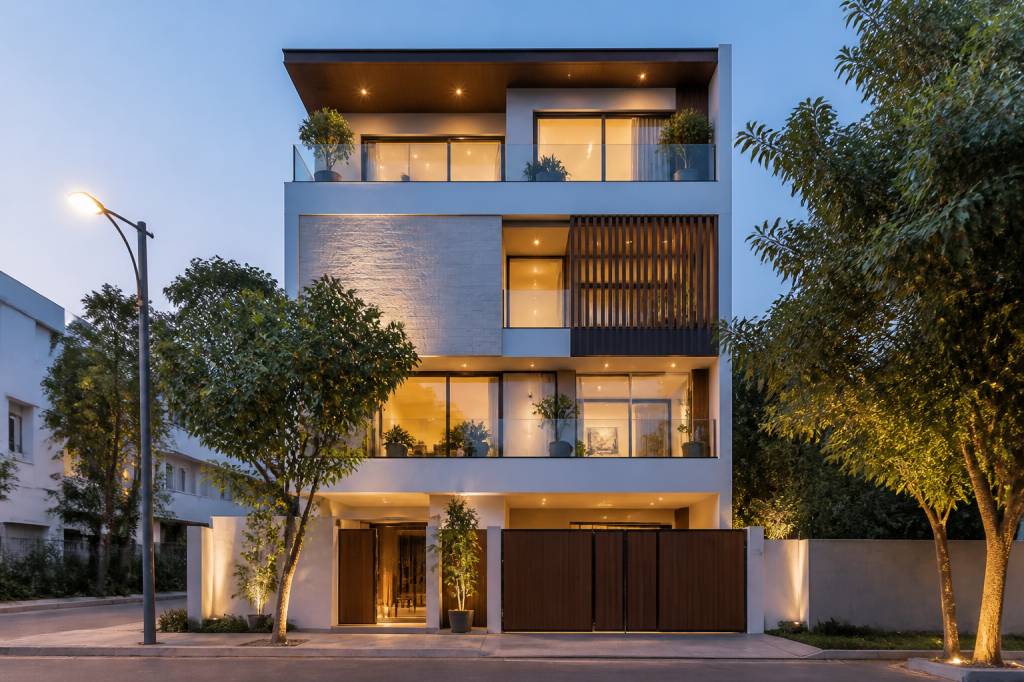
Designing a four-story home is a different exercise from styling a compact apartment or even a standard two-storey house. You are not just arranging rooms; you are choreographing movement, light, privacy, storage, structure, and daily routines across multiple levels. Get it right, and the house feels calm, spacious, and remarkably easy to live in. Get it wrong, and you end up with a lot of stairs, awkward circulation, and rooms that look good on paper but fail in real life. Not ideal.
The good news? Modern four-story home design gives you plenty of opportunities to make each level work harder. Whether you are planning a new build, rethinking a vertical extension, or renovating an existing tall property, the right layout can transform the way the house functions. Below are four practical design ideas that suit contemporary living, along with the kind of details that matter when you are actually trying to build or remodel the thing.
Prioritise a clear vertical zoning strategy
The single biggest mistake in multi-storey homes is treating each floor as an isolated box. In a modern home, every level should have a defined role. That does not mean each floor must be rigidly assigned forever, but it does mean you should be intentional about how the house is stacked.
A strong vertical zoning strategy usually looks something like this:
This arrangement works because it separates noisy and quiet functions, and it gives each floor a clear purpose. In one renovation project I reviewed, the family originally had the kitchen on the lowest level and the living room two floors up. They spent years carrying groceries, laundry, and children between levels like unpaid porters. Once the main living area was moved to the most accessible middle floor, the house immediately felt more logical.
When planning the stack, ask yourself what happens most often in the house. Where do people gather? Where is laundry handled? Where do you want privacy? The answers should shape the layout far more than any glossy mood board.
Practical tip: keep the most-used spaces closest to the main entrance or closest to where natural light is best. If your staircase is long and your daily routine involves carrying trays, bedding, or shopping bags, every extra level matters.
Budget note: reorganising floors in a renovation can be expensive if it involves structural work, plumbing relocation, or new fire separation. As a rough guide, internal reconfiguration in a multi-storey home can range from moderate to high cost depending on how much you need to move. Always get at least three quotes and check whether the proposed changes affect load-bearing walls or escape routes.
Make the staircase a design feature, not an afterthought
In a four-story home, the staircase is not just a means of transport. It is the spine of the house. If it is poorly placed, narrow, dark, or visually heavy, the whole property can feel tiring. If it is designed well, it becomes a central organising element that improves both circulation and the sense of space.
Modern staircase design should do three jobs at once: connect levels efficiently, admit light, and avoid visual bulk. Open risers, slim balustrades, and floating treads can help create a lighter feel, but they are not always the right answer. In homes with children or older residents, safety, grip, and comfort matter more than a sculptural effect. This is where real-world design beats Instagram design every time.
Here is what to consider:
A four-storey house usually benefits from at least one stairwell design move that brings light deep into the building. This could be a rooflight above the stair core, a glazed side wall, or internal windows from adjacent rooms. Even small interventions can make a dramatic difference. If you have ever walked into a stairwell that feels like a vertical cupboard, you know why this matters.
For budgets, a straightforward internal staircase replacement may be manageable, but a custom-made stair in steel, timber, and glass can quickly become a significant investment. Expect costs to vary widely based on structure, finish, and local regulations. On larger projects, factor in engineer involvement and building control approval from the outset.
Time-wise, a custom stair can take several weeks to design and fabricate, then a few days to install. The mistake is leaving it too late. The stair should be designed early, not chosen from a catalogue when everything else is already fixed.
Use natural light to soften the height of the building
Four-storey homes can easily feel vertical in the wrong way: lots of height, not much warmth. Natural light is the best tool for preventing that. It helps stitch the floors together, makes circulation areas more pleasant, and reduces the feeling that you are living in a stacked set of corridors.
The goal is not simply to add more windows. It is to distribute light strategically so each floor feels connected to the others and to the outside. That often means working with the roof, the stair core, and any available double-height voids.
Some effective strategies include:
One of the smartest moves in a tall house is to treat the stairwell as a light well. Instead of making it a dark transitional zone, use it as the house’s vertical brightening shaft. That can be as simple as a rooflight and a pale wall finish, or as ambitious as a full-height glazed stair enclosure.
Material choice plays a role too. Light-coloured plaster, matte finishes, pale oak, and off-white joinery help reflect daylight. Dark finishes can look dramatic, but if you overuse them in circulation spaces, you risk making the house feel narrower and more enclosed than it actually is.
Do not ignore overheating, especially on upper floors. More glass means more daylight, but also more solar gain. Specify appropriate glazing, external shading, or blinds where needed. A bright house that becomes unbearable in summer is not clever design; it is a planning headache with better styling.
If you are renovating, ask your architect or designer to model daylight early in the process. It is much easier to adjust openings on paper than after walls are built and everyone is pretending the dim landing has “character”.
Create flexible rooms that can change function over time
Modern living rarely stays static. A top-floor office may become a teenage den, a guest room may need to double as a homework area, and a lower-level family room may eventually become a quiet retreat. In a four-story home, flexibility is not a luxury; it is a practical requirement.
The best approach is to design certain rooms with a “soft function”. That means the room has a primary purpose, but can be adapted without major work. This is especially useful on upper floors where space is too valuable to waste on a room that only works one way.
Useful design moves include:
A good example is a fourth-floor room designed as a studio. With a fold-down desk, a compact wardrobe, and a sofa bed, it can shift from work zone to guest suite in minutes. That is far more useful than a highly specific room with a giant built-in feature wall that looks impressive but blocks every future option.
If the house is for a growing family, think about how the upper floors will change in five or ten years. Teenagers want independence. Guests need privacy. Someone may start working from home permanently. Design that anticipates these shifts is money well spent.
There is also a resale angle here. Buyers love flexibility, but they dislike awkwardness. A room that can be understood instantly and repurposed easily tends to appeal more than a niche layout that only suits one household.
Balance storage and circulation so the house does not feel cluttered
In a tall home, storage problems multiply quickly. If you do not plan storage carefully, every floor becomes a landing zone for random items: shoes on the stairs, coats on chairs, toys in hallways, and laundry baskets living permanently in transit. Vertical living makes organisation essential.
Good storage in a four-storey house should be distributed, not concentrated in one heroic cupboard somewhere on the lowest level. You need storage where items are actually used.
Think in zones:
Built-in storage under stairs, in eaves, or around the stair core can be incredibly efficient, provided you do not sacrifice circulation width. In a tall home, circulation is sacred. A hallway that is too narrow or too packed with storage quickly feels oppressive.
One practical rule: if storage doors open into a route you use daily, you probably need to rethink the layout. A beautiful cabinet is not very beautiful when it blocks access to the bathroom every morning.
For materials, durable painted MDF, veneered plywood, and well-finished joinery-grade timber are common choices for built-ins. If the house is busy or family-heavy, choose finishes that can handle scuffs and repeated use. Glossy surfaces may look sleek at first, but they can reveal wear, fingerprints, and bad lighting very quickly.
Time and budget for joinery can vary massively. Off-the-shelf storage is cheaper and faster, but built-in solutions usually deliver better long-term function in multi-storey homes. If you want the house to feel calm rather than constantly busy, storage deserves real attention, not just a token cupboard.
Plan the services and maintenance access from day one
This is not the glamorous part, but it is the part that prevents future regret. A four-story home has more complexity in plumbing, electrics, heating, ventilation, and maintenance access than a lower house. If you do not plan for it early, repairs become expensive and disruptive.
Modern living needs systems that are easy to service. That means making sure plant locations, inspection points, shut-off valves, and cable routes are sensible. It also means thinking about how someone will actually carry out maintenance on upper floors, roofs, or concealed service zones.
Ask these questions before finalising the design:
It is boring until the day a leak appears behind a finished wall or an extractor fan fails on the top floor. Then it becomes very interesting, very quickly.
If you are renovating, a good contractor will help you map out service access before the decorative finishes go in. If you are starting from scratch, insist on coordination between architect, structural engineer, MEP consultant, and interior designer. Yes, it sounds like overkill. No, it usually is not.
The most successful four-storey homes are not just visually strong. They are easy to maintain, comfortable to navigate, and adaptable over time. That is the real definition of modern living: not just stylish spaces, but spaces that work when the novelty wears off and everyday life takes over.
If you approach the design with clear zoning, a well-considered stair core, strong daylight planning, flexible rooms, and proper storage and services, a four-story house can feel surprisingly effortless. That is the aim, after all. Not to impress visitors once, but to make the whole building function beautifully every day.