


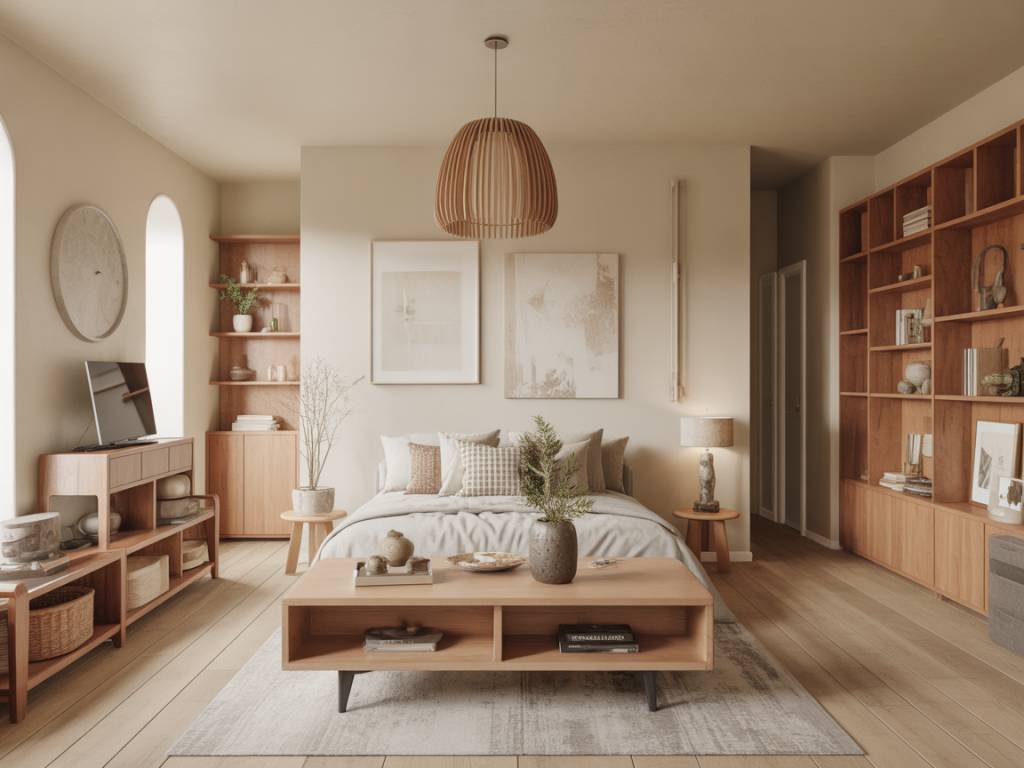
If you’ve ever stood in the middle of your living room wondering why your new oak sideboard “fights” with your walnut coffee table, you’re not alone. Mixing natural wood tones in a contemporary interior is one of those topics that paraît simple… jusqu’au moment où les pièces arrivent chez vous.
The good news: you don’t need an interior design degree to get it right. You do, however, need a method. Let’s break it down like a project: clear steps, simple rules, and concrete examples you can apply straight away.
Why mixing wood tones works in contemporary interiors
In a contemporary space, wood is often your main tool to avoid the “cold showroom” effect of white walls, large windows and minimal furniture. Mixing wood tones:
-
Adds depth and visual interest without clutter.
-
Makes new, flat-pack pieces coexist with older, character pieces.
-
Softens hard materials like concrete, glass, metal and stone.
The aim is not to have “matching” wood everywhere. The aim is a controlled, harmonious mix – like a palette. Think “curated contrast” rather than “random patchwork”.
Start here: define the mood and the base tone
Before you pull out wood samples, decide what you want the room to feel like. This will determine the base wood tone that sets the scene.
Ask yourself:
-
Do you want the space to feel warm and cozy, or calm and airy?
-
Do you prefer Scandinavian lightness, Japanese minimalism, or more of a loft / hotel vibe?
Then choose one dominant category of wood for the room:
-
Light woods (oak, birch, ash, light maple): ideal for bright, contemporary, Scandinavian-inspired interiors. Good in small or dark rooms.
-
Medium woods (classic oak tones, teak, some walnuts): warm and versatile. Easy to mix with others and with existing parquet.
-
Dark woods (walnut, wenge-style stains, smoked oak): more dramatic, hotel or “designer” effect. Demands more light and simpler lines.
Generally, it’s easier to get a coherent look if:
-
The floor is your dominant wood tone (it’s the largest surface).
-
Large fixed elements (kitchen, built-ins) follow the same family.
-
Smaller furniture and accessories bring in controlled variation.
Understand undertones: the technical bit that changes everything
Where mixes go wrong is rarely the “light vs dark” decision. It’s undertone.
Each wood or wood-look finish has an undertone:
-
Warm undertones: yellow, orange, red (pine, some oaks, cherry, beech, many “honey” stains).
-
Cool undertones: grey, taupe, slightly greenish (smoked oak, some walnuts, “driftwood” finishes).
-
Neutral undertones: balanced, neither very yellow nor very grey (many natural oaks and ash when not heavily stained).
The safe rule:
-
Stay within the same undertone family in a given room – or choose one warm + one cool, but then keep the rest neutral.
How to check undertones in real life:
-
Place samples or product photos on a sheet of pure white paper. The underlying color “temperature” jumps out.
-
Compare two woods directly: one will look more yellow/red, the other more grey/neutral.
-
Avoid judging based only on online photos – always ask for a sample or see the piece in natural light if possible.
Limit your palette and choose a dominant wood
In residential projects, the mixes that age well are not those with eight different types of wood. They’re the ones with a controlled palette.
As a guideline:
-
Floor + big pieces + accents = 3 main wood tones maximum in one room.
Example of a calm, contemporary palette:
-
Floor: light natural oak (dominant).
-
Dining table: slightly darker oak, same warm undertone.
-
Accents: black stained wood (chairs or coffee table) to structure the space.
Example of a more contrasted, graphic palette:
-
Floor: medium oak.
-
Kitchen fronts: dark walnut veneer.
-
Open shelving: very light ash or birch to “lift” the whole.
The dominant wood should appear at least in two different elements (e.g. floor + dining table, or kitchen + shelving) so that it feels intentional, not accidental.
Play with texture and finish, not just color
Two woods can be the same color and still clash if one is ultra-shiny and the other very rustic. In a contemporary interior, texture is your ally to avoid a “flat” look without adding visual noise.
You can mix:
-
Matte vs satin finishes: for example, a matte oak table with slightly satin oak chairs still feels coherent.
-
Smooth vs textured: a flat kitchen front with a more pronounced grain on open shelving.
-
Fine vs rustic grain: but keep this under control; too many rustic pieces can quickly feel country rather than contemporary.
What to avoid in most contemporary projects:
-
Too many high-gloss wood finishes in the same room (very 2000s kitchen look).
-
Combining very rustic reclaimed wood with ultra-red cherry and yellow pine, unless the contrast is assumed and balanced by a lot of neutral surfaces.
Use contrast intentionally
Contrast keeps the eye awake. The key is to make it look like a choice, not like you furnished the room over ten years without a plan.
Some reliable combinations:
-
Light floor + dark furniture: classic, graphic, works especially well in open-plan living / dining. Keep wall colors fairly light to avoid a heavy feel.
-
Dark floor + light furniture: warmer and more sophisticated. Ideal if you like hotel vibes. Make sure the room has enough natural or artificial light.
-
Medium floor + both light and dark accents: the most flexible but also the easiest to overload – respect the “3 wood tones” rule.
When you add a contrasting piece (e.g. one dark walnut console in a light oak room), echo that tone elsewhere:
-
Frame of a mirror.
-
Legs of a chair or stool.
-
Small shelf or side table.
The repeated accent makes the new wood look “planned” instead of “odd one out”.
Connect your woods with neutrals and metals
If wood is the melody, neutrals are the background and metals are the rhythm. They help everything make sense together.
Use neutral elements to “separate” conflicting woods:
-
A plain rug under a contrasting table to avoid direct wood-on-wood clash.
-
A painted skirting between parquet and wood panelling.
-
White, off-white, or greige walls to calm a busy floor.
Metals can also unify the composition:
-
Black metal (handles, legs, lighting) pairs equally well with light and dark woods and reinforces the contemporary line.
-
Brushed brass or bronze warms up cool wood tones and adds depth without being bling.
-
Stainless steel or chrome is more demanding: it suits cooler woods and minimal interiors but can look cheap with very warm orange woods.
Practical rules of thumb (for non-designers)
If you don’t want to analyse undertones for hours, use these shortcuts:
-
If your floor is yellowish oak or pine, avoid woods that are very red or very grey. Stay in similar warm tones or clearly darker browns.
-
If your floor is grey or smoked, avoid very orange woods. Choose taupe, walnut, black, or very pale neutral wood.
-
Do not try to fake a “perfect match” between two different woods. Aim for a deliberate difference instead of a “nearly the same but not quite” effect.
-
Repeat each wood tone at least twice in the room.
-
When in doubt, choose lighter and more matte: easier to live with, ages better, and visually enlarges the space.
Room-by-room: concrete examples that work
Let’s look at some combinations you can actually implement, with indicative budgets and complexity.
Living room: existing medium oak floor
Context: Parquet in a typical European flat, medium oak with a slightly warm undertone.
Goal: Update to a more contemporary look without changing the floor.
Mix that works:
-
Sofa with black metal legs (or black stained wood legs).
-
Oak TV unit slightly lighter than the floor, matte finish.
-
Walnut coffee table (darker, more sophisticated tone) on a large neutral rug to disconnect from the floor.
-
Two light ash side tables, echoing the TV unit but lighter to avoid too much “oak on oak”.
Indicative budget (France / EU, entry to mid-range):
-
TV unit in veneer oak: 300–800 €.
-
Coffee table in walnut or walnut veneer: 200–600 €.
-
Rug 200×300 cm: 150–500 €.
-
Side tables: 50–200 € each.
Complexity: low. You’re working with freestanding furniture, no tools needed. The key decision is the rug: if it’s too busy, you lose the calm contrast.
Kitchen: light oak floor, new IKEA-type kitchen
Context: Light oak laminate floor. You’re planning a budget kitchen with standard cabinets.
Goal: Mix wood tones without making the kitchen disappear into the floor.
Mix that works:
-
Base units in matte white or light greige.
-
Upper units in wood-effect slightly darker and cooler than the floor (avoid “same same”).
-
Open shelf in solid oak close to the floor tone to “link” the two levels.
-
Worktop in compact laminate or quartz, light but not white (stone-look, concrete-look).
-
Handles and profiles in black or dark bronze to give rhythm.
Indicative budget:
-
Standard kitchen (6–8 m²) with mixed fronts: 2 500–5 000 € installed, depending on appliances.
-
Worktop upgrade from basic laminate to compact or quartz: +700–2 000 € depending on length and material.
Complexity: medium. The crucial point is to bring samples of floor + cabinet fronts + worktop together before ordering. Do not rely on catalogue photos alone.
Bedroom: dark floor, small surface
Context: Dark stained parquet in a small bedroom. You’re afraid to make it feel even darker with more wood.
Goal: Keep it cozy but light, with a contemporary feel.
Mix that works:
-
Bed frame in very light oak or ash, simple lines.
-
Bedside tables matching the bed, or in white with a light wood top.
-
Wardrobe in white, greige or wall color, with only the handles in dark wood or black metal.
-
One dark wood accent (chair, frame, or small shelf) matching the floor stain.
Here, the dark floor becomes a base, not a weight. You are essentially mixing two wood tones: very light and very dark, connected by neutral walls and fabrics.
Common mistakes to avoid
Before you click “order”, check that you’re not falling into one of these traps:
-
Choosing everything online without samples: every screen is calibrated differently, and wood stains vary by batch. Order samples or visit a showroom for key pieces (flooring, kitchen, dining table).
-
Trying to match an old varnished floor exactly: you will end up with “almost matches” that look off. Assume the difference and choose clearly lighter or clearly darker pieces.
-
Mixing too many “fake” wood patterns (laminate, melamine, vinyl) with exaggerated grain. If you already have a strong faux wood floor, keep furniture finishes more subtle and solid-colored.
-
Ignoring lighting: a wood that looks soft beige in daylight can turn orange under warm bulbs. Check your samples in the actual room light, day and night.
-
Forgetting about future additions: leave yourself a margin. If your palette is already on the edge of chaos, adding one more random wood chair will tip it over.
Shopping checklist before you buy the next piece
When you’re about to invest in a table, wardrobe, or set of chairs, run through this quick checklist:
-
What is my dominant wood in this room? (Usually the floor or a big built-in.)
-
Does the new piece belong to the same warm / cool / neutral family, or is it a deliberate contrast?
-
Will this add a new wood tone or repeat one that’s already present? (Aim to repeat.)
-
Am I about to exceed three main wood tones in this room?
-
Have I seen the real finish (sample, showroom, or at least user photos in real homes)?
-
Where will the new wood directly touch another wood? Do I have a rug, painted element, or metal to separate them if needed?
-
Will I be able to echo this tone elsewhere later (a frame, a small shelf, chair legs)?
If you answer “yes” to most of these questions, you’re not buying blindly – you’re building a consistent palette.
Mixing natural wood tones is less about talent and more about process. Observe your existing elements, define your base, choose your contrasts with intention, and let repetition do the rest. With a bit of discipline and a few samples on the table, your contemporary interior will feel layered, warm and coherent – without looking like a furniture catalogue or a chalet theme park.