


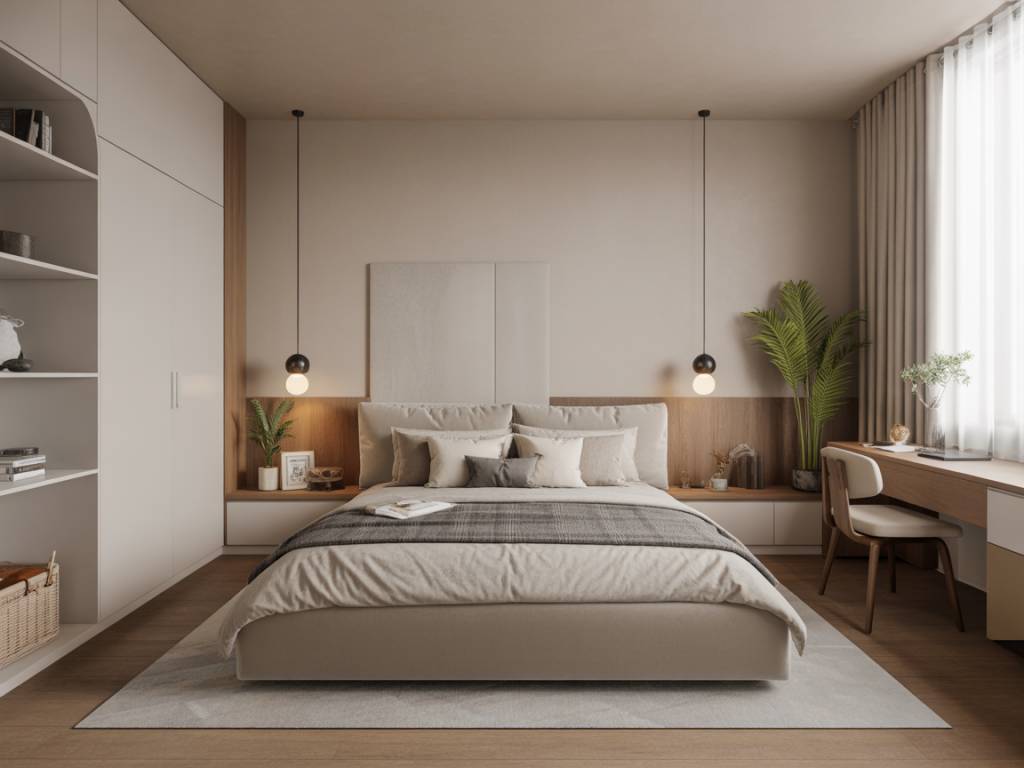
When people tell me they “want a minimalist bedroom”, they usually mean two things: they want to sleep better, and they’re tired of living dans le bazar. The Pinterest images sont jolies, mais comment on passe d’une chambre encombrée à une pièce vraiment reposante, sans pour autant vivre dans un décor de magazine vide et froid ?
Dans cet article, on va traiter la chambre comme ce qu’elle est vraiment : une pièce technique dédiée au sommeil. On va parler circulation, rangements, lumière, matériaux, budget et petits travaux réalistes à faire un week-end… ou à confier à un pro quand c’est plus prudent.
Start with the function: what do you really do in your bedroom?
Before you move furniture or buy anything beige, you need a clear brief. A minimalist bedroom that fonctionne n’est pas la même pour tout le monde.
Ask yourself, and be honnête:
-
Is this room only for sleep and dressing, or do you also work/scroll/read/watch series here?
-
Do you share it with a partner, a baby, a pet… all of the above?
-
How much storage has to live here (clothes only, or also luggage, paperwork, sports gear)?
-
Are you sensitive to light/noise/temperature?
Minimalism isn’t about owning “nothing”; it’s about removing tout ce qui parasite la fonction principale. For better sleep and serenity, that means :
-
No visual clutter (too many objets, couleurs, meubles).
-
No functional clutter (desk overloaded, piles of laundry, cartons qui traînent).
-
No sensory clutter (écran, lumière agressive, bruit, chaleur excessive).
Write down your constraints. This will guide chaque décision de design, et vous évite de vous perdre dans les tendances.
Declutter strategically: what actually stays in a minimalist bedroom?
Before touching the layout, you must reduce the volume. Sinon, vous déplacerez juste le problème d’un coin à l’autre.
Target inventory for a functional minimalist bedroom might be:
-
Bed + mattress + 2 pillows/person + simple bedding rotation
-
1–2 bedside tables or shelves (or none, for ultra-minimal)
-
1 closed wardrobe or built-in closet
-
Possibly 1 chest of drawers or bench with storage
-
1 chair or small armchair (optional, mais pas un porte-vêtements déguisé…)
-
2–3 sources of light max (ceiling + lamp(s) de chevet)
-
Very few decorative items (1–2 frames, 1 plant, 1 vase, etc.)
Action plan over one weekend:
-
Day 1 – Tri brutal
Empty your bedside tables and surfaces into three piles on the floor: keep in bedroom, move to another room, donate/recycle/bin. Same for books, beauty products, tech devices, clothes that stay “en transit” sur la chaise. -
Day 2 – Clothing edit
If your wardrobe explodes, your bedroom ne sera jamais minimaliste. Without doing a full “capsule wardrobe”, target a clear objective: enough clothes for 3–4 weeks, rangés dans des meubles fermés. Seasonal items can go in boxes under the bed ou dans une autre pièce.
Budget & time
-
Time: 4–8 hours depending on volume and your capacité à décider.
-
Budget: 0 € if you only tri. 50–150 € if you need extra storage boxes, vacuum bags, or donation pick-up services.
Point de vigilance: ne tombez pas dans le “je garde au cas où”. Chaque objet gardé doit avoir une place définie, invisible au premier coup d’œil.
Plan the layout: circulation and calm sightlines first
Minimalist design starts with how you move dans la pièce. You want a clear path from:
-
Door → bed
-
Bed → window
-
Bed → wardrobe
Rules of thumb for a calming layout:
-
Prioritise the bed wall
If possible, place the headboard against a full wall (no window), with view of the door but not aligned with it. This creates a feeling of safety (principe qu’on retrouve en feng shui, mais aussi dans l’architecture hôtelière). -
Leave breathing space around the bed
Aim for at least 60 cm circulation space each side. If the room is narrow, keep one side at 60 cm and accept that the other will be tighter—but avoid coller un côté du lit contre le mur sauf contrainte extrême. -
Group storage
Wardrobe + chest of drawers should be aligned on one wall, ideally opposite or adjacent to the bed, not tous éparpillés. The goal: one “activity zone” for getting dressed, one “zone sommeil” autour du lit. -
Limit furniture
Ask of every piece: does it serve sleep or storage? That decorative console table you only dust une fois par mois n’a peut-être pas sa place ici.
Small room trick: if you’re under 9–10 m², consider a bed with integrated storage drawers or a lifting base. It lets you supprimer un meuble bas and keep the room visually quiet.
Budget: 0 € if you only rearrange. 30–150 € if you need gliders for furniture, cable management, or a basic wall plug relocation by an electrician pour libérer une tête de lit.
Choose a calm, coherent color palette
Minimalist doesn’t mean “all white”, especially si vous vivez dans un pays gris six mois par an. You need a palette that supports sleep: low contrast, few colours, matte finishes.
Safe palettes that work in most bedrooms:
-
Warm neutrals: shades of warm white, beige, greige, taupe. Cosy, easy à assortir, pardonne les petites variations de lumière.
-
Soft cool tones: blue-grey, sage green, light stone. Apaisants, mais attention à ne pas rendre la pièce froide si l’orientation est nord.
-
Light + dark contrast (dosé): murs clairs, tête de lit ou mur derrière le lit légèrement plus foncé pour donner de la profondeur sans sur-stimuler.
Where to use which colour:
-
Walls: 1–2 shades maximum, finition mate (évite les reflets agressifs).
-
Ceiling: souvent un ton plus clair que les murs pour ouvrir l’espace.
-
Bed linen: uni ou micro-motifs discrets, dans les mêmes tons que les murs ou légèrement contrastés.
Budget & time
-
Paint: 30–60 € / 10 L pot for good mid-range; bedroom often needs 2–3 pots depending on size.
-
Time: 1–2 days DIY for prep + 2 coats (prévoir bâches, ruban de masquage, petits défauts de mur).
Point de vigilance: faites un test de couleur sur deux murs (un qui reçoit la lumière, un plus sombre) et regardez-le matin, midi, soir. Une teinte “calme” en showroom peut devenir verdâtre ou rosée chez vous.
Select materials that support rest: soft, matte, breathable
Minimalist bedrooms work because they limit the number of textures—but they les choisissent bien.
Focus on three key surfaces:
Bedding: your main “tool” for sleep
Invest here before you achetez un nouveau luminaire design.
-
Mattress: choose en fonction de votre position de sommeil and body type. Too soft = mal de dos; too hard = points de pression. Test at least three models in-store and stay allongé 10–15 minutes, even si vous vous sentez un peu ridicule.
-
Sheets: natural, breathable fibres (cotton percale, linen, viscose from bamboo) in 200–400 TC range are suffisants. Higher thread count is not automatically better, and often retient plus la chaleur.
-
Colours & patterns: solids or very subtle patterns, harmonised with your wall palette.
Budget benchmarks (queen size):
-
Mattress: 400–900 € for good mid-range (below 300 €, quality drops vite; au-dessus de 1 000 €, vérifiez que le marketing suit la réalité).
-
Bed linen set: 60–150 € for durable, comfortable sets.
Flooring: warm underfoot, visually quiet
You see the floor en grand format dès que vous entrez. It must be calm visually and agréable au toucher.
-
Keep if: you already have hardwood, quality laminate or a neutral, matte tile. Add an area rug near the bed (wool or cotton, couleurs sobres).
-
Improve if: you have cold, shiny, patterned tiles or degraded carpet. Options: click laminate in a warm wood tone, or cork flooring for acoustic and thermal comfort.
Budget & time (12–15 m²):
-
Laminate: 20–40 €/m² supply + possible 25–40 €/m² installation by a pro. 1–2 days de pose.
-
Rug: 120–300 € for a large (160×230 or 200×300) wool-blend, plus anti-slip mat.
Limit tech and visual noise
Minimalist bedroom = low stimulation. Every écran added is un ennemi potentiel du sommeil profond.
To audit:
-
TV in bedroom?
-
Laptop on the nightstand?
-
Multiple chargers, cables, clignotements de LED?
-
Open shelving packed with books and objets?
Action steps:
-
Move all non-essential tech out. If you work from your bedroom par contrainte, séparez clairement un coin bureau (paravent, rideau, or at least a desk you can close).
-
Use a simple alarm clock instead of your phone on the nightstand.
-
Hide cables: trunking, cable sleeves, or simply rerouting them behind furniture.
-
Prefer closed storage over open. A minimalist bedroom with étagères remplies est une contradiction.
Budget: 20–80 € pour accessoires de gestion de câbles, boîte de rangement, réveil simple. Time: 1–2 hours.
Design lighting for sleep, not for Instagram
Light is one of the most under-estimated tools for better sleep. Minimalist design = peu de sources, mais bien choisies.
Target three layers:
-
General light (ceiling): a simple, closed fixture with a warm white bulb (2700–3000K), dimmable if possible. Avoid spotlights criards or LEDs too cold.
-
Bedside light: lamps or wall sconces with soft, directional light. Ideal for reading without éclairer tout le plafond. Switch reachable from bed.
-
Accent light (optional): a small floor lamp or LED strip inside a wardrobe for practicality, not pour “faire joli”.
Rules:
-
Max 3–4 light sources in the whole room.
-
Only warm colour temperatures. No 4000–6000K ici.
-
Try smart bulbs or a simple dimmer to reduce intensity 1 hour before bed.
Budget & time:
-
Fixtures: 30–80 € per basic, decent-quality light; 60–150 € for nice design pieces.
-
Electrician (if new points needed): 80–120 €/hour, prévoir 1–3 hours selon complexité.
Point de vigilance: think about where the switches are. Being forced to cross a dark room to turn off the light est tout l’inverse d’une expérience calme.
Smart storage: invisible but efficient
You can’t have serenity with piles of stuff everywhere. The goal is to maximize closed storage that blends into the room, and minimize what stays visible.
Strategies that work well in minimalist bedrooms:
-
Built-in or wall-to-wall wardrobes
If budget and structure allow it, a full-height wardrobe (floor to ceiling, one entire wall) with plain doors, same colour as the walls, est la solution la plus minimaliste. It visually disappears. -
Under-bed storage
Drawers integrated into the bed frame or low boxes on wheels for things you rarely need (suitcases, seasonal bedding). Keep them neat; sinon vous recréez un grenier sous le matelas. -
Headboard with niches
A custom or modular headboard with small recessed shelves peut remplacer les tables de chevet et limiter les objets visibles.
Inside the wardrobe, compartimentez:
-
Boxes for small items (underwear, accessories)
-
Uniform hangers to avoid visual chaos
-
1 shelf “en rotation” for current week clothes or pyjamas
Budget & time:
-
Custom wardrobe: 1 000–4 000 € depending on size, materials, and interior fittings. 1–3 days de pose.
-
Modular wardrobes (IKEA, etc.): 400–1 500 € and one intense weekend de montage.
-
Under-bed options: 40–200 € selon système.
Point de vigilance: don’t overload the room with “storage furniture” pieces all different. It’s better to invest in one big coherent block than trois petits meubles dépareillés.
Add just enough character to avoid a sterile look
Minimalist doesn’t mean “hospital room”. The risk, especially with beige-on-beige, is to end up in an impersonal decor that ne ressemble pas à votre vie.
So where do you add personality without recréer le bazar ?
-
One statement element
Choose one focal point: a beautiful headboard, a textured rug, a large framed print, or a sculptural bedside lamp. Not all of them at once. -
Textiles with texture
Think linen duvet cover, a knitted throw, a wool rug. Keep colours quiet, play on relief instead. -
Nature
1–2 plants maximum (easy-care, pas une jungle). Or a branch in a simple vase, some dried flowers, a photography of a landscape.
Rule: before you add a decorative element, ask “what does it do for my sleep?”. If the answer is “rien, mais c’est mignon”, réfléchissez deux fois.
Step-by-step roadmap: from cluttered to minimalist in 30 days
If you prefer an action plan plutôt qu’un grand discours, voici une version condensée.
-
Week 1 – Audit & tri
List what the room must contain. Remove everything that doesn’t serve sleep or dressing. Donate/sell/store elsewhere. -
Week 2 – Layout & palette
Reposition bed and storage for clear circulation. Choose wall colours and test patches. Order any big pieces needed (bed frame, wardrobe). -
Week 3 – Works & essentials
Paint walls if needed. Install or rearrange storage. Adjust lighting (change bulbs, move or add bedside lamps). -
Week 4 – Textiles & fine-tuning
Select bedding, rug, curtains in a cohesive palette. Add 1–2 personal touches (art, plant). Hide cables. Do a final edit: remove at least 5 objects qui ne servent à rien ici.
At the end, your bedroom should feel simple, easy to keep tidy, and slightly empty compared to what you’re used to. C’est normal. Give yourself two weeks to get used to it before you jugez le résultat.
If you wake up plus reposé, if you tidy less and sleep more, then your minimalist design works. And si ce n’est pas encore le cas, reprenez le processus: souvent, ce n’est pas que vous n’avez pas “assez décoré”, c’est que vous avez encore trop gardé.