


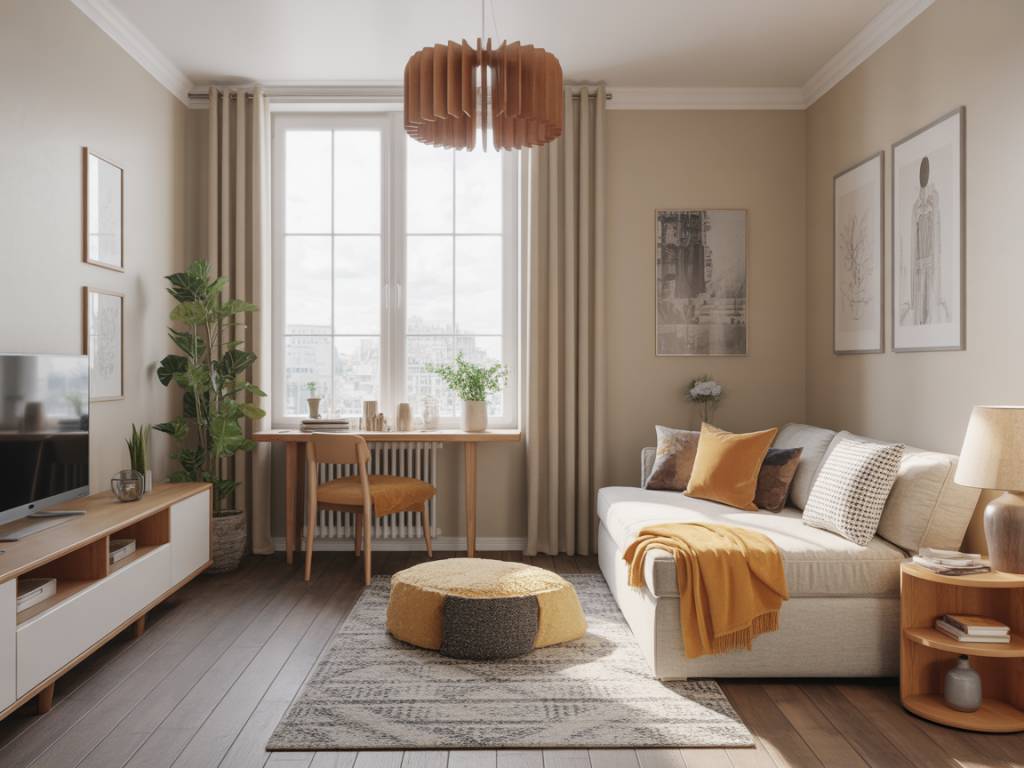
Living in a compact home isn’t a downgrade. It’s a design challenge. And if you treat it comme un vrai projet – with a plan, a budget and a few rules – you can get an interior that feels bigger, calmer and much more functional than many large but poorly designed flats.
Let’s go through the main interior tricks that actually work in small spaces, with concrete actions you can implement this month, even if you’re renting.
Start with the right mindset (and a tape measure)
Before buying yet another “space-saving” gadget online, pause. Good small-space design is 80% planning, 20% furniture.
Ask yourself:
- What do I really do at home? (Work? Host friends? Cook? Mostly sleep?)
- What are my pain points? (No storage? Dark? Can’t move around the table?)
- What can I realistically change? (Paint, furniture, lighting, layout, but maybe not walls?)
Then, measure everything:
- Room dimensions: length, width, ceiling height.
- Openings: windows, doors, radiators, sockets.
- Circulation paths: minimum 70–80 cm to walk comfortably.
Use a simple scale plan (paper is fine: 1 cm = 50 cm) to move furniture around before you move it in real life. You’ll avoid the classic mistake: buying a sofa that eats the room.
Define zones, not rooms
In a compact home, you rarely have one room per function. The goal is to make one surface do several jobs, without feeling like you live in a storage unit.
List the functions you need, then assign them to zones instead of rooms:
- Sleep
- Work / study
- Relax / TV
- Eat
- Store (clothes, papers, cleaning, hobbies)
For each zone, choose:
- 1 main piece (bed, desk, table, sofa)
- 1 storage type (wardrobe, shelves, drawers)
- 1 light (task or ambient)
Then, separate these zones visually instead of physically:
- Rugs to anchor the living area.
- Paint blocks (a coloured rectangle behind the bed headboard, for example).
- Furniture (a back-to-sofa shelf to separate living and sleeping).
- Light (a pendant above the dining table, a floor lamp by the sofa).
Budget: you can set up clear zoning from around 150–300€ (rugs, a couple of lamps, paint) without touching walls.
Layout tricks that instantly make a room feel bigger
Certain layout rules are almost non-negotiable in tight spaces.
Free the centre, load the edges
Try to keep the middle of the room as empty as possible. Push storage and heavier pieces against walls and into corners.
- Prefer a sofa against a wall, not floating in the middle.
- Place tall storage in the least visible corner from the entrance.
- Use low furniture between windows to avoid blocking natural light.
Respect circulation lines
Always keep a “clear line” from the door to windows and key zones. If you constantly have to turn sideways to pass, the layout is wrong.
- Leave 70–80 cm in front of wardrobes and kitchen units.
- Around a bed: aim for at least one side with 60 cm free space.
- Around a dining table: 80–90 cm from table edge to wall is comfortable.
Use corners intelligently
- Corner desks where two walls meet: great mini home office.
- Corner shelves above 1.80 m: storage that doesn’t hit your head.
- L-shaped sofas against two walls: define the living zone in one move.
Folding and nesting pieces
- Drop-leaf or folding wall-mounted table (80–150€) for kitchen/dining.
- Nesting side tables instead of a massive coffee table.
- Folding chairs that hook on a wall or slide under the sofa.
Think vertical: every centimetre counts
Most small homes waste at least 20–30% of their storage potential because the walls are half empty. The ceiling height is your best ally.
Go up to the ceiling
- Install wardrobes or shelving that reach all the way up.
- Use the top shelves for low-access items (suitcases, seasonal clothes).
- Unify tall storage with the same colour as the wall to reduce visual bulk.
Indicative budget for vertical storage:
- DIY wall shelves (brackets + boards): from 60–120€ per wall.
- Standard wardrobe with top units: 250–600€ depending on width and interior fittings.
- Made-to-measure from floor to ceiling: 800–1500€ per wall, depending on materials.
Use “dead” zones
- Above doors: a simple shelf for books or boxes.
- Under windows: low cabinets or benches with storage.
- Behind doors: hooks or shallow shelves (depth 10–15 cm) for accessories and small items.
Lofted beds and platforms
If your ceiling is 2.80 m or higher, consider:
- A mezzanine bed with desk or wardrobe underneath (from 700–2000€ depending on system).
- A raised platform with storage drawers under the bed or sofa.
Points of vigilance:
- Check minimum headroom above a mezzanine bed (ideally 90 cm at least).
- Ensure structure is fixed properly and complies with safety standards.
- Verify rental restrictions before drilling into structural elements.
Choose furniture that does several jobs
Every piece in a compact home should justify its presence. Ideally, it does two things at once.
Multi-functional essentials
- Sofa bed with proper mattress if you sleep there every night. Budget: 600–1500€ for a comfortable model.
- Bed with storage drawers or lift-up base: replaces one full dresser.
- Bench with storage around the table: seating + hidden space for linens, board games, paperwork.
- Desk with drawers: avoid separate chests for office supplies.
Favour “light” designs
- Leggy furniture (visible floor underneath) makes the room feel less packed.
- Glass or slim-top tables visually “disappear”.
- Open bases (metal frames, slender wooden legs) look less massive than full plinths.
When custom is worth it
Custom-built pieces are more expensive upfront but can replace several standard items:
- Built-in wall unit with TV, books and closed storage: from 1500–4000€ depending on materials and finishes.
- Custom bench-seat with storage along a wall: 600–1500€.
If you plan to stay more than 5 years, custom work often makes sense in terms of comfort and resale value.
Light, mirrors and colours: optical tools that actually work
Small spaces don’t forgive bad lighting or random colour choices.
Layer your lighting
- General light: ceiling or large floor lamp to avoid dark corners.
- Task lights: lamp on the desk, reading lamp by the sofa/bed, focused spots in the kitchen.
- Atmosphere: LED strips under shelves, small table lamps.
Try to have at least 3 light sources in the main room. With LED bulbs, the running cost stays low. Choose warm white (2700–3000K) for living and sleeping areas, neutral white (3500–4000K) for work zones.
Use mirrors strategically
- Place a large mirror opposite or at 90° to a window, never directly facing the door (you want depth, not a bounce-back effect).
- Prefer tall, narrow mirrors (almost full height) to visually increase the ceiling height.
- Mirror-front wardrobes can double the perceived width of a room.
Budget: full-height mirror (50–80 cm wide) runs from 80–250€ depending on frame and quality.
Colour rules for compact homes
- Light, warm neutrals enlarge and soften: off-white, greige, linen, sand.
- Use darker tones to structure: one accent wall, niches, lower half of walls.
- Keep contrast under control: too many dark/light clashes break the space visually.
- Paint doors and their frames the same colour as the wall to “erase” them.
Simple, effective combo: light neutral on walls, slightly darker neutral on doors and skirting, one deeper accent colour in the living zone or behind the headboard.
Materials and textures: make small feel solid, not cheap
In a small home, every surface is under your eyes all the time. Weak materials or overly busy patterns will tire you out quickly.
Flooring
- Use the same flooring throughout the main living areas to unify the space.
- Prefer medium tones over very light or very dark (they show less dirt and visually “ground” the room).
- Click vinyl, laminate or engineered wood are good options for small budgets.
Approximate prices (supply only):
- Laminated floor: 10–25€/m².
- Click vinyl: 20–40€/m².
- Engineered wood: 35–70€/m².
Walls and textiles
- Keep wall patterns under control: one feature wall or a small area, not every surface.
- Invest in good curtains: full-height, installed high above the window to elongate the wall.
- Opt for textured fabrics (linen, cotton, wool) instead of lots of small decorative items.
Tip: if the floor is visually busy (small tiles, strong pattern), keep walls and main furniture very calm.
Room-by-room quick wins
Let’s look at a few typical compact situations and what you can actually do this month, with or without a contractor.
Micro living room / studio main space
- Choose one main seating piece: a 2–3 seater sofa (140–180 cm wide) or a good armchair + pouf, not both if the room is tiny.
- Add a small table that adjusts (nesting tables, a lightweight round table, or a lift-top coffee table that doubles as desk).
- Use a medium-sized rug to define the area; leave at least 10–20 cm of flooring visible all around to avoid the “wall-to-wall carpet” effect.
- Mount the TV on the wall or on a very shallow media unit (30–35 cm deep).
- Store seldom-used items in boxes under the sofa or in a storage ottoman.
Indicative mini budget (entry level, new): 800–1500€ for sofa, rug, table, simple media unit and a couple of lamps.
Small bedroom
- Pick the biggest bed you can fit comfortably while keeping at least one side with decent circulation (60 cm).
- Use a bed with drawers or a lift-up base to store bedding, off-season clothes, suitcases.
- Replace bulky bedside tables with narrow shelves or wall-mounted small units.
- Install wardrobes up to the ceiling; use interior organisers (hanging rods at two levels, drawers, vertical dividers).
- Limit decor to a few strong elements: a headboard, two lamps, one or two artworks.
Trick: if the room is very narrow, place wardrobes along one wall and paint everything (doors, frames, wardrobes) the same colour as the wall to visually “erase” the block.
Tiny bathroom
- Choose a shallow vanity unit (30–40 cm deep) with drawers instead of doors.
- Replace the pedestal sink with a wall-hung cabinet to free floor space.
- Use mirrored cabinets above the sink for everyday items.
- Install hooks and bars on the back of the door for towels and bathrobes.
- Prefer large-format tiles with thin grout lines to reduce visual breaks.
Check waterproofing standards and ventilation before making heavy changes. In a rental, you can still upgrade storage and lighting without touching plumbing.
Entrance and circulation areas
Even 1 m² at the entrance can radically change daily life if it’s well optimised.
- Add a narrow console (depth 20–30 cm) or a wall shelf for keys and mail.
- Install hooks or a hanging rail for coats; add a shoe cabinet only if it doesn’t block the door.
- Use a small rug or runner to define the entrance and protect the floor.
- Place a mirror to check yourself before going out and bounce light back into the flat.
Declutter with a method, not guilt
A small space amplifies every object. If you don’t control inflow, no layout trick will save you.
Instead of a vague “I should have less”, set concrete rules:
- One in, one out for clothes, books, decorative objects.
- Dedicated “overflow” box per category (e.g. max one box for paperwork waiting to be sorted).
- Quarterly 1-hour declutter session per room, scheduled like an appointment.
Questions to ask yourself before keeping an item:
- Did I use it in the last year?
- Would I buy it again today?
- Would I pay to store it somewhere else?
The goal is not minimalism at all costs, but alignment between what you own and what you can comfortably house.
Typical mistakes to avoid in compact homes
- Buying “mini” everything: 6 tiny chairs, 4 mini tables, 10 small lamps. Result: clutter. Better 2–3 well-chosen, slightly larger, multi-use pieces.
- Overdecorating the walls: collage of frames, shelves, hooks everywhere. Leave some breathing space.
- Blocking natural light: tall wardrobes in front of windows, heavy dark curtains permanently closed.
- Ignoring storage depth: a 60 cm deep wardrobe in a 2 m wide room will feel like a wall. Sometimes 40–45 cm is enough with hangers placed sideways.
- Rushing to drill: in rentals, plan reversible solutions first (tension rods, over-door hooks, freestanding shelves).
If you’re unsure, live with the empty space for a week instead of spontaneously filling it. Gaps often show you where you really need a piece – and where you don’t.
Small space design is a long game: adjust, observe how you move, tweak again. With a clear plan, a tape measure and a realistic budget, your compact home can have a far bigger impact than its square metres suggest.