


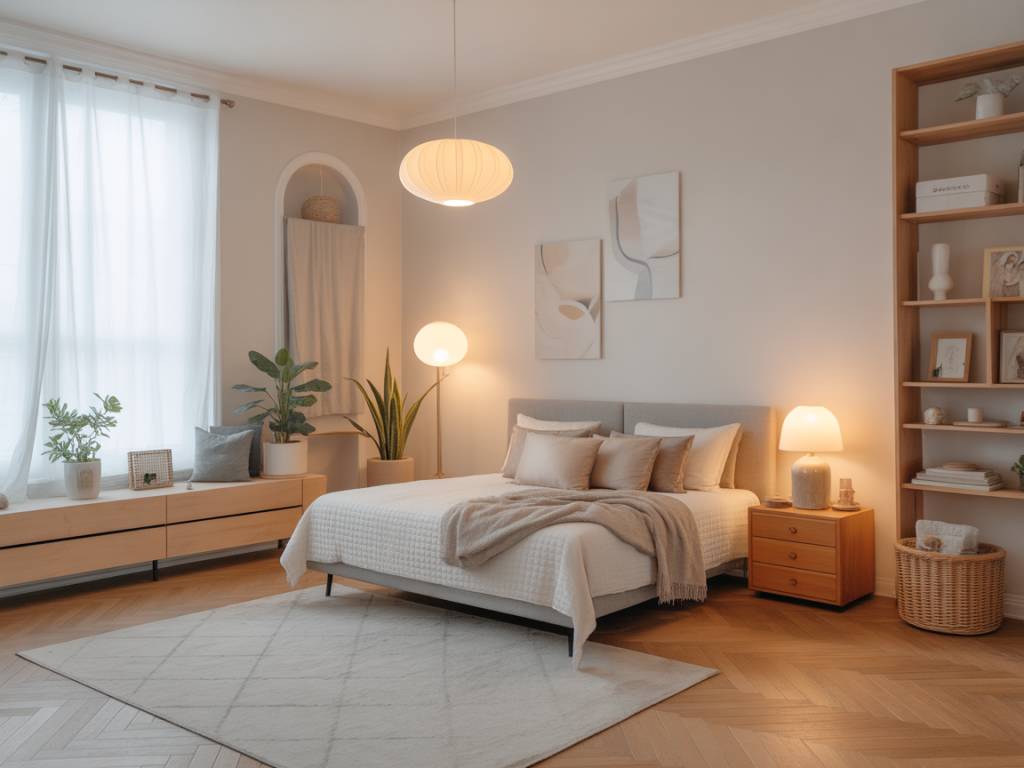
Why smart tech and minimalism actually work well together
Smart home and minimalism sound, at first glance, like opposites. More câbles, plus d’applis, plus d’objets… où est la simplicité là-dedans ? In practice, a well-designed smart home can remove visual noise, daily frictions and mental charge — exactly what a minimalist lifestyle is aiming for.
The key is this: technology must disappear dans le décor. You shouldn’t “see” your smart home, you should feel it — in the form of fewer switches to think about, less energy wasted, and a home that quietly s’adapte to you.
In this article, we’ll go through the essentials that make sense in a minimalist home, how to plan them, what budget to prévoir, and the traps to avoid so you don’t end up with a gadget museum.
Rules of a minimalist smart home
Before buying anything, set a few ground rules. They will help you say “no” to 80 % of gadgets that look cool but add zero value to your daily life.
- Less devices, more functions. Prefer one hub or one speaker that centralises several uses (audio, assistant, automation) instead of multiples petits objets partout.
- Neutral design, hidden when possible. White or black, clean lines, flush in walls, behind doors or in ceilings. No rainbow LEDs unless you really assume the look.
- Interoperability first. Choose devices that speak a common language: Matter, Zigbee, Z-Wave, HomeKit, Google Home, Alexa… Pick an ecosystem and stick to it.
- Automation over remote control. A minimalist smart home doesn’t mean “more apps and remotes”. The goal is that things happen without you having to think about them.
- Privacy and security are non-negotiable. Fewer cloud dépendances, regular updates, and strong network hygiene are part of the design.
Keep these in mind as a check-list every time a new product hits your feed and you feel your finger gliding toward the “Buy now” button.
Start with the invisible layer: network and power
Every renovation or new build should treat connectivity as seriously as plumbing or electricity. If your Wi-Fi is flaky, no “smart” feature will feel seamless.
Elements to plan (before paint and furniture):
- Wi-Fi infrastructure: a decent router + possibly a mesh system for homes over ~80–90 m² or with thick walls.
- Ethernet points: behind the TV, near your main desk, near the media cabinet or smart hub. Câbles may not be sexy, but they’re stable.
- Enough power sockets: especially at ceiling level (for Wi-Fi access points, presence sensors) and near doors/windows (for motorised blinds).
- Neutral wire at switches: mention this to your électricien if you plan smart switches; many models require a neutral conductor in the box.
Budget & timing (for a typical apartment, 60–80 m²):
- Router + 1–2 mesh nodes: 150–300 €
- Extra ethernet runs and sockets: 300–800 € (if done during renovation)
- Extra power outlets + switch boxes with neutral: 300–600 €
- Timing: 1 jour pour le réseau, 1–2 jours pour les compléments électriques (hors finitions murs/peinture)
Point de vigilance : don’t underestimate coverage. Test your Wi-Fi at all corners before closing ceilings or finalising furniture layout. Moving an access point by 2 m is easier before the painter comes.
Smart lighting: the biggest impact for daily comfort
If you’re going to start with one category, choose lighting. It changes your perception of space, supports a minimalist décor (less lamps, better planned), and is relatively easy to retrofit.
Two main approaches:
- Smart bulbs (Philips Hue, Ikea Tradfri, etc.)
Pros: easy to install, flexible, changeable colors/temperatures.
Cons: each luminaire depends on the bulb; classic switches must stay ON, which is not very “minimalist” in daily life. - Smart switches or modules (Fibaro, Legrand Netatmo, Shelly, Aqara, etc.)
Pros: wall switches remain usable, invisible tech, you can keep your favourite minimalist fixtures.
Cons: requires intervention at the electrical panel or behind switches (electrician recommended).
For a minimalist home, a consistent plan works well:
- Use simple, dimmable white light (2700–3000 K in living areas, 4000 K in work zones).
- Create 2–3 main scenes instead of 20: “Day”, “Evening”, “Night”.
- Add presence sensors only where they really help: couloir, WC, buanderie, entrée.
- Decide which lights must work even if Wi-Fi or hub are down (stairs, bathroom). Those should stay as basic as possible.
Budget example for a 70 m² minimalist flat:
- 5–7 smart modules or switches: 40–70 € / pièce → 200–400 €
- 2–3 presence sensors: 25–60 € / pièce → 50–150 €
- Electrician (installation + programming de base): 300–600 €
- Total lighting smartisation: 550–1 150 € approx.
Temps à prévoir : 1 journée pour la pose + quelques soirées pour affiner les scènes et réglages. Ne bâclez pas cette phase : une bonne scène lumière se teste sur plusieurs jours, à différents moments.
Climate control: comfort without clutter
Thermostats and smart heating/cooling controls are a perfect match for a minimalist lifestyle: they reduce visual clutter (moins de radiateurs allumés “au cas où”), simplify routines, and optimise energy use.
Options selon votre installation :
- Chauffage individuel (chaudière, pompe à chaleur): un thermostat connecté central (Tado°, Netatmo, Nest…) + éventuellement têtes thermostatiques connectées sur certains radiateurs.
- Chauffage collectif avec robinets thermostatiques: privilégiez des têtes connectées uniquement dans les pièces de vie clés et la chambre.
- Climatisation split: certains modèles sont directement connectés, sinon on peut ajouter des contrôleurs infrarouge “intelligents”.
Règles minimalistes :
- Un thermostat mural bien placé, design discret (blanc, forme simple).
- Des programmes clairs : “Semaine / Week-end / Absence”, plutôt que des scénarios compliqués.
- Géolocalisation optionnelle (baisse automatique quand tout le monde est parti), si vous acceptez cette collecte de données.
Budget indicatif :
- Thermostat connecté: 150–300 €
- Têtes thermostatiques: 50–80 € / radiateur (souvent packs à prix dégressif)
- Pose par un pro (si nécessaire): 150–300 €
Temps à prévoir : installation en 1–3 heures, puis 1–2 semaines pour ajuster les consignes en fonction de votre confort réel.
Security that doesn’t feel like a control room
Caméras partout, écrans, câbles, notifications incessantes… ce n’est pas l’idée. The goal is quiet protection: you forget it’s there, until it matters.
Éléments simples et efficaces pour un appartement ou une petite maison :
- Smart lock (optionnel mais très pratique) : pour gérer les accès (enfants, aide-ménagère, location courte durée) sans multiplier les clés.
- Contacteurs d’ouverture sur la porte d’entrée et éventuellement les accès sensibles (terrasse, arrière-cour).
- Une ou deux caméras intérieures max, bien placées, si et seulement si vous êtes à l’aise avec ça.
- Détecteurs de fumée et monoxyde connectés pour recevoir des alertes même en votre absence.
Design & intégration :
- Choisir des capteurs petits, de la même couleur que murs ou boiseries.
- Limiter le nombre de “bips” et voyants lumineux. Certains détecteurs ont un mode discret sans LED permanente.
- Désactiver toutes les notifications non essentielles (par exemple, la porte qui s’ouvre à chaque fois que quelqu’un sort les poubelles… non).
Budget :
- Smart lock: 200–350 € + éventuelle pose par serrurier
- Contacteurs d’ouverture: 20–40 € / pièce
- Caméra intérieure de qualité: 80–200 €
- Détecteur fumée/CO connecté: 70–150 €
Automations: where the “seamless” truly happens
Owning smart devices is one thing; making them work together, en silence, c’est autre chose. This is where routines and scenarios come in.
Principes pour éviter le chaos :
- Automations basées sur l’état (sunset, presence, mode “Away”) plutôt que sur l’heure fixe uniquement.
- Limiter les dépendances à l’Internet : préférez les automatisations locales quand c’est possible.
- Nommer clairement vos pièces, scènes et appareils (“Living – Ceiling”, “Bedroom – Reading lamp”) pour ne pas vous perdre après 6 mois.
Quelques scénarios minimalistes à fort impact :
- Routine du matin: à partir d’une heure ou de la détection de présence dans le couloir: légère montée en température, lumières douces dans la cuisine, volet du séjour qui s’entrouvre.
- Mode “Tout éteindre”: un bouton près de la porte d’entrée qui coupe toutes les lumières, arrête la musique, baisse le chauffage de 1–2 °C.
- Mode “Soirée calme”: lumières à 30 %, température stable, notifications désactivées sauf alertes sécurité.
- Mode “Vacances”: éclairages simulant une présence, chauffage en éco, alertes renforcées si ouverture porte/fenêtre.
Vous n’avez pas besoin de 40 scénarios. Visez 4–6 routines maîtresses qui couvrent 80 % de votre vie quotidienne.
Planning your smart minimalist home: step-by-step
Instead of buying piece by piece au gré des promos, structure the project comme un mini-chantier.
Étape 1 – Clarifier vos usages
- Listez vos irritants quotidiens (oublier d’éteindre, lumière trop forte le soir, thermostat trop bas le matin…).
- Notez vos contraintes spécifiques (enfants, télétravail, animal, location courte durée…).
- Ciblez 3–5 objectifs concrets: “baisser notre facture énergie de 15 %”, “supprimer 80 % des gestes d’éclairage manuels”, etc.
Étape 2 – Choisir un écosystème central
- Si vous êtes très Apple: HomeKit / Matter.
- Si vous avez déjà des enceintes Google ou Amazon: Google Home / Alexa.
- Si vous aimez bricoler: Home Assistant sur un mini-ordinateur (plus technique mais très puissant).
Étape 3 – Définir un budget global
- Pour un 60–80 m² déjà rénové: comptez 1 000–2 500 € pour un ensemble cohérent (réseau, éclairage, chauffage, quelques capteurs) hors gros travaux.
- En rénovation lourde: vous pouvez intégrer plus de câblage et de modules encastrés pour le même budget matériel, mais il faudra ajouter la main d’œuvre électrique.
Étape 4 – Commencer par un “pilote”
- Choisissez une pièce pilote (souvent le séjour ou la chambre).
- Implémentez éclairage + chauffage + une automatisation simple.
- Vivez avec 2–3 semaines, ajustez, puis seulement dupliquez la recette au reste du logement.
Étape 5 – Documenter vos choix
- Tenez un simple fichier (ou carnet) avec:
- Liste des appareils (marque, modèle, emplacement)
- Schéma simplifié de l’installation (surtout éclairage et réseau)
- Identifiants d’accès (stockés de manière sécurisée)
Cela vous évitera le classique “on a tout installé il y a 3 ans, mais plus personne ne sait comment ça marche”.
Frequent mistakes that ruin the minimalist effect
Quelques erreurs reviennent systématiquement sur les chantiers, y compris chez les gens très organisés.
- Trop d’objets visibles: multiprises, box, petits hubs, ponts, alimentations… Anticipez des endroits pour tout cacher (meuble media ventilé, placard technique).
- Mélanger trop de marques et protocoles: au début ça va, puis les mises à jour arrivent, une appli disparaît, un cloud ferme… Limitez-vous à 2–3 grands fabricants fiables.
- Automatisations trop agressives: lumières qui s’éteignent quand vous ne bougez pas pendant un film, volets qui se ferment en plein dîner, etc. Prévoyez toujours une option “override manuel” simple.
- Oublier les contraintes d’invités: un système doit rester compréhensible pour quelqu’un qui ne vit pas chez vous. Gardez des interrupteurs physiques et modes simples.
- Négliger la sécurité informatique: mot de passe “123456”, pas de mises à jour, pas de séparation entre réseau invité et réseau principal… Si vous faites entrer des objets connectés chez vous, prenez 30 minutes pour sécuriser le tout.
A realistic example: a clean 2-bedroom smart minimalist flat
Pour vous donner un ordre de grandeur, voici un scénario type pour un appartement de 70 m², déjà rénové, dans un registre très épuré.
Pièces : entrée + séjour/cuisine ouverte + 2 chambres + salle de bain + WC.
Équipements choisis :
- Réseau: routeur + 1 point d’accès mesh → 250 €
- Éclairage:
- 6 modules de commande encastrés (séjour, cuisine, couloir, WC, SDB, chambre principale) → 6 × 50 € = 300 €
- 2 détecteurs de présence (couloir, WC) → 2 × 40 € = 80 €
- Chauffage:
- 1 thermostat connecté pour chaudière → 220 €
- 3 têtes thermostatiques (séjour, 2 chambres) → 3 × 60 € = 180 €
- Sécurité:
- 1 smart lock sur porte d’entrée → 280 €
- 1 contacteur d’ouverture porte + 1 pour la fenêtre donnant sur terrasse → 2 × 30 € = 60 €
- 1 détecteur fumée connecté → 100 €
- Hub / Assistant vocal:
- 1 enceinte connectée design (salon) → 120 €
Total matériel approximatif : ~1 590 €
Main d’œuvre (électricien + configuration de base) : 600–900 € selon région et complexité.
En échange, vous obtenez :
- Un appartement où 80 % des allumages/extinctions se font automatiquement.
- Une gestion de chauffage optimisée et presque invisible.
- Un système de verrouillage pratique, sans portier vidéo envahissant.
- Un seul assistant vocal discret pour piloter le tout à la voix si besoin.
Visuellement, les seuls indices “smart” seront: un thermostat mural, une enceinte élégante, un barillet de porte un peu différent. Tout le reste se cache dans les murs et les plafonds.
Keeping it simple over time
Un dernier point: un smart home minimaliste doit le rester. C’est un système vivant, qui évolue avec vos besoins. La clé est de résister à l’accumulation.
Règles d’entretien :
- Planifiez 2 fois par an un “audit” de 30 minutes:
- Mettre à jour les firmwares.
- Supprimer les scénarios jamais utilisés.
- Vérifier les comptes et accès (invités, anciennes applis…).
- Pour chaque nouvel objet envisagé, posez-vous:
- Quel problème concret cela résout-il ?
- Puis-je faire la même chose avec un appareil que j’ai déjà ?
- Va-t-il s’intégrer proprement dans mon écosystème existant ?
- Gardez un plan B manuel pour les fonctions vitales (éclairage, chauffage, serrure) en cas de panne réseau ou serveur.
Un smart home réussi ne se remarque pas sur vos murs, mais dans la façon dont vos journées coulent plus facilement. Si, en entrant chez vous, vous n’avez plus à penser aux interrupteurs, au chauffage, aux volets ou à la clé à ne pas oublier, alors vous êtes sur la bonne voie vers un quotidien réellement minimaliste — assisté par la technologie, mais jamais dominé par elle.