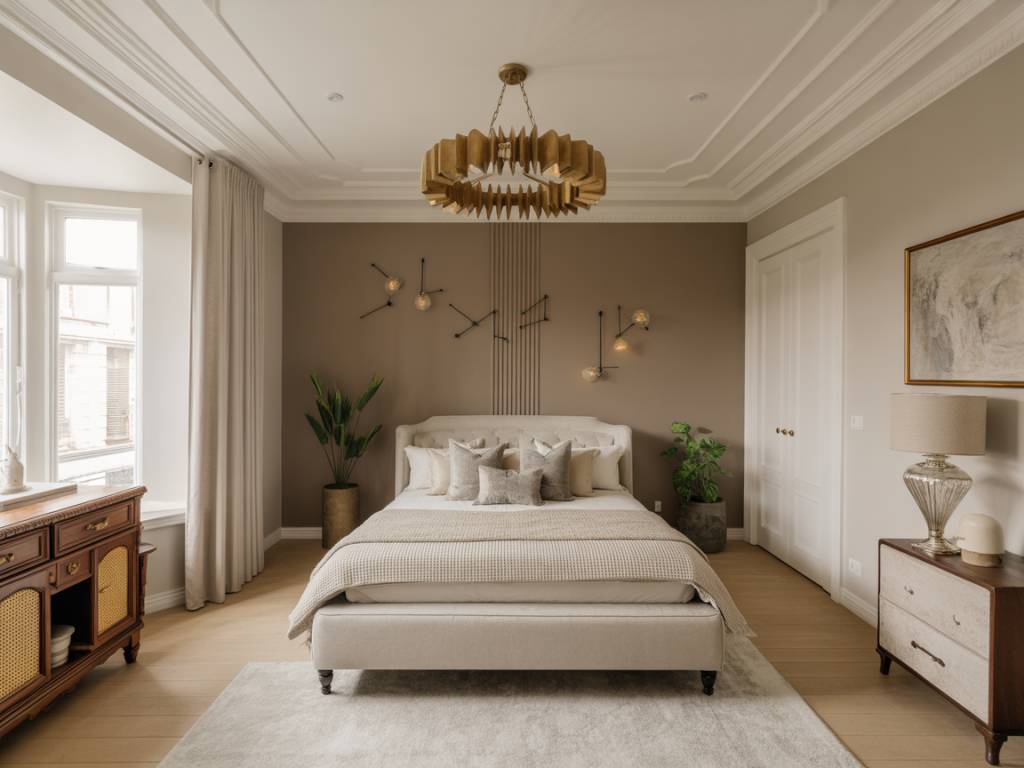
Why your next feature wall should be… the ceiling
For years, the “feature wall” has been the go-to trick to dynamise a room without repainting everything. A darker colour behind the sofa, a patterned wallpaper behind the headboard, and you were done.
The problem? This trick has been so overused that it often blends into the background. In many interiors, the feature wall doesn’t surprise anymore – it’s predictable.
The new playground for designers and architects is now above your head: the accent ceiling. Instead of pretending the ceiling doesn’t exist, we use it as a fifth wall – sometimes even as the main decorative statement of the room.
If that sounds risky, stay with me. Used intelligently, an accent ceiling can structure a space, balance volumes and even solve layout problems. The key is to know how to use it: materials, colours, budget, and also what to avoid.
What is an accent ceiling – and why is it so powerful?
An accent ceiling is simply a ceiling that is deliberately highlighted by colour, material or shape to become a key design element in the room, instead of a neutral plane painted white by default.
Compared with a traditional feature wall, the ceiling has three big advantages:
- It doesn’t “eat” usable wall space: you keep your walls free for storage, windows, radiators, art or shelves.
- It unifies the room: an accent wall attracts the eye to one side; the ceiling works on the entire footprint of the room.
- It can visually correct proportions: too high? too long? too narrow? The ceiling is your best tool to rebalance.
Of course, the effect can be spectacular – but only if you choose the right technique for your space, your budget and your constraints (height, lighting, existing structure, etc.).
When an accent ceiling makes sense (and when it doesn’t)
Before you take out the paint roller, ask yourself three questions:
- What do I want to correct or highlight?
Low ceiling to “lift”, high ceiling to warm up, overly long room to break up, lack of character, poor lighting… An accent ceiling is a tool, not just a decorative whim. - What are my real constraints?
Ceiling height, condition of the existing support (cracks, stains, beams), presence of utilities (ducting, spotlights, smoke detectors), rental vs. ownership. - What is my budget + time frame?
A weekend and 150 € is not the same project as a 5,000 € budget and professional plasterers.
Situations where an accent ceiling works particularly well:
- Open-plan living spaces where you need to visually zone functions: kitchen / dining / living
- Bedrooms with very little wall space (sloping ceilings, many openings)
- Long, narrow rooms that feel like corridors
- High ceilings that make the room feel cold or “echoey”
- Small spaces where you can’t add much furniture or wall decor (entry, WC, dressing)
Cases where it’s wiser to be careful:
- Very low ceilings (below 2.40 m) where a dark or heavily textured ceiling can compress the volume
- Rooms already very busy visually (heavy patterned wallpapers, many colours, lots of furniture)
- Spaces with very poor natural light where the ceiling is the only luminous surface
Painted accent ceiling: the most accessible option
If you want to test the concept without blowing your budget, paint is your best ally. With a good preparation and two coats, you can totally change a room in a weekend.
Budget estimate (DIY, 15–20 m² room):
- Paint (quality acrylic): 50–90 €
- Prep + tools (roller, telescopic pole, masking tape, tarp): 30–60 €
- Total DIY: around 80–150 €
- With a painter (France, average): 20–35 €/m² of ceiling, labour + materials
Which colours to choose?
- Dark ceiling in large or high rooms
Deep blue, charcoal, bottle green, even black. A dark ceiling “brings down” the height visually, creates intimacy and highlights mouldings or lights.
Ideal in: living rooms with 2.80 m+ height, period apartments, master bedrooms. - Coloured ceiling to energise a neutral base
Terracotta, muted sage, dusty pink, linen, sand. Perfect to warm a white-box new build without repainting all the walls.
Ideal in: rentals, small living rooms, children’s rooms. - Ceiling + wall in the same colour (enveloping effect)
Painting the ceiling and at least one wall in the same shade creates a cocooning atmosphere and masks irregularities at the junction surfaces.
Ideal in: bedrooms, reading nooks, home offices.
Technical tips (the stuff professionals actually do):
- Always check the existing paint type (water-based vs. oil-based). If in doubt, do a test patch and use an adhesion primer.
- Prepare seriously: dust, fill cracks, sand lightly, remove loose plaster. A dark colour will exaggerate defects.
- Use a satin or matte finish for ceilings. Gloss will show every flaw.
- Protect the walls with 2–3 cm of masking tape along the junction and remove it before the paint is completely dry to avoid tearing.
- Work your roller in the direction of the light (towards the main window) to minimize roller marks.
Wooden ceilings: warmth and acoustic comfort
If your goal is to warm up a cold room or hide a very damaged ceiling, wood is an excellent candidate. It also improves acoustics and brings a real architectural presence.
3 main options:
- Wood panelling (planks or slats)
Mounted on battens or clips, in solid wood or MDF veneer. Wide planks for a Scandinavian vibe, narrow slats for a more contemporary feel.
Budget (excluding labour): 25–70 €/m² depending on essence and quality. - Open slat ceilings (slatted baffle style)
Wooden slats spaced out, often with black felt behind, very graphic.
Benefits: hides utilities and spot rails while letting sound absorb and air circulate.
Budget materials: 50–120 €/m². - Wood-effect panels
Laminated or PVC panels imitating wood, lighter and more economical, interesting in bathrooms or rentals where you can’t significantly add load.
Budget: 15–40 €/m².
Points of vigilance:
- Height loss: count at least 3–5 cm for battens + panels, more if you integrate spotlights.
- Weight and fixing: check the ceiling structure (concrete, brick, plasterboard) and use appropriate anchors.
- Fire and humidity: in kitchens and bathrooms, choose treated wood or adapted panels and respect local fire safety regulations.
Where wood ceilings work particularly well:
- Large living spaces where you want a strong warm identity
- Duplexes or lofts where the ceiling is visually very present
- Home cinemas or music rooms where acoustics matter
Structural accent ceilings: beams, coffers, dropped ceilings
Sometimes the accent is already there – you just need to reveal it.
Existing beams
- Strip layers of paint, sand and either wax, oil or stain the beams to bring out the wood.
- Paint the infill between beams in a contrasting colour to highlight the rhythm.
- In very low rooms, often it’s better to keep beams and infill in the same light tone to avoid cutting the height.
Coffered ceilings and frames
- Create a central frame in plasterboard with LED strips recessed inside.
- Paint the inside of this “tray” in a stronger colour: you get a sort of inverted feature wall.
- Useful in open-plan spaces to visually mark a dining area or living area without partitions.
False ceilings for lighting
- A dropped ceiling (plasterboard) of 10–20 cm allows you to integrate spotlights, LED strips, ventilation ducts, etc.
- To turn it into an accent, combine:
- structured shape (island above the kitchen, band above the hallway)
- colour or different material (paint, wood, acoustic panel)
- integrated lighting (peripheral LEDs, recessed spots)
Budget range (indicative, with pros):
- Simple dropped plasterboard ceiling: 40–70 €/m² (supply + installation, excluding finish paint)
- Coffered or complex shaped ceiling: often 80–150 €/m² depending on design and lighting
Bold options: wallpaper, colour blocking, pattern on the ceiling
For small surfaces or “secondary” rooms (entry, WC, hallway), the ceiling can become a playground.
Wallpaper on the ceiling
- Very impactful in small surfaces: floral paper in a powder room, graphic pattern in a hallway, panoramic in a bedroom above the bed.
- Use non-woven wallpaper (paste-the-wall) which is easier to apply overhead.
- Be realistic about your DIY level: applying wallpaper upside down is significantly more physical than on walls.
Budget (DIY):
- Mid-range non-woven wallpaper: 20–40 €/roll (5 m² on average)
- Adhesive and tools: 20–40 €
Colour blocking and stripes
- Extend a wall colour 30–50 cm onto the ceiling to visually “frame” the space.
- Create a coloured rectangle on the ceiling above the dining table or bed to define the zone.
- Draw stripes or a geometric design on the ceiling to visually shorten or widen a room:
- Stripes along the short side to “stretch” length
- Stripes along the long side to “widen”
These techniques cost little in materials but require precision in marking and masking tape. Take the time to measure, draw with a chalk line and do tests.
Lighting: the ally that makes or breaks an accent ceiling
An accent ceiling without a lighting strategy is like a kitchen without sockets: you’ll regret it daily.
Think lighting before you build anything (false ceiling, wood slats, frames). Ask yourself:
- Do I need a general light, task lighting, ambient light – or all three?
- Where are my existing electrical points? Can I move them or do I use them as is?
- Do I want to highlight the ceiling (washing it with light) or simply integrate lights discreetly?
Three approaches that work well with accent ceilings:
- Perimeter LEDs
Recessed LED strip around the perimeter of a dropped ceiling or frame. It gives a floating effect and highlights textures (wood, relief paint, coffers). - Clustered pendants
Particularly effective with painted or patterned ceilings: a group of pendants above a table or island draws the eye up and emphasises the chosen area. - Accent spots
Adjustable spotlights aimed at specific points on the ceiling (pattern, beam, art) to create depth and shadows.
On a practical level, plan for:
- Access hatches if you hide junction boxes or transformers above a false ceiling
- Dimmable lighting where possible – a dramatic accent ceiling under a 4,000 K cold spotlight is rarely a success
- LED strips and spots with good CRI (colour rendering index) so your chosen colour or material is not distorted
Step-by-step: how to plan your accent ceiling project
Whether you only repaint or go for a full structural modification, the logic stays the same.
1. Diagnose your existing situation
- Measure the height at several points (especially in old buildings).
- Identify visible defects: cracks, stains, sagging, traces of old leaks.
- Note existing electrics: junction boxes, connection points, smoke detectors, VMC vents.
2. Define your objective
- Is it mainly aesthetic (add character)?
- Functional (hide utilities, improve acoustics, correct proportions)?
- Both? In that case, prioritise: what is non-negotiable?
3. Choose your technique
- Paint only (minimal intervention)
- Paint + lighting adaptation
- Wood or panels (with or without false ceiling)
- Structural (dropped ceilings, coffers, slats)
- Wallpaper or pattern (small/medium surfaces)
4. Set your budget and level of DIY
- Paint: easily DIY if you’re comfortable working overhead and prepping.
- Wallpaper overhead: intermediate to advanced, or delegate.
- Wood / plasterboard / electrics: generally best done by pros, unless you already have experience.
Get at least two quotes if you involve trades. Ask them:
- What are the surface prep steps?
- What materials are planned (brands, technical specs)?
- How much height will be lost, exactly?
- What happens if existing ceiling is worse than expected once open?
5. Plan the schedule
- Paint only: 1–2 days for an average room (including prep and drying).
- False ceiling + paint + lighting: 3–7 days depending on complexity.
- Wood slats or panels: 2–5 days, often with drying time for finishes.
And yes, expect dust and some disruption: cover furniture, protect floors, and if you’re redoing multiple rooms, organise work zone by zone.
Common mistakes to avoid
After years on renovation sites, here are the recurring traps around accent ceilings:
- Choosing colour in the shop only
Always test a patch directly on the ceiling and observe it morning, noon and evening. A grey that looks soft under neon lights can become almost blue at home. - Ignoring the rest of the room
An accent ceiling that has no link with the walls, the floor or furniture will look arbitrary. Reuse the same tone in at least two other elements (textiles, artwork, accessories). - Underestimating surface preparation
Cracks, stains, joints between plasterboard plates – the ceiling reveals everything. Don’t skip filler, sanding and priming, especially for dark shades. - Forgetting future changes
If you’re adding a complex structure, think about access for future electrical or plumbing work. A superb coffered ceiling that needs to be opened the first time you change a spotlight is not a success. - Overloading low spaces
In very low ceilings, prefer light colours, subtle textures, and slight contrasts rather than very dark or visually heavy materials.
Where to start if you’re hesitant
You don’t have to start with your living room. To test the concept without stress, the most forgiving rooms are:
- The entry: small surface, strong impact, and you see it several times a day.
- The WC: perfect for bold wallpaper or strong colour overhead.
- A hallway or passage: an excellent place for a coloured or patterned “strip” that guides movement.
Choose a technique that matches your skills (often paint at first), monitor the effect for a few weeks, and adjust in your next project. Many homeowners start with a simple coloured ceiling in the hallway… and then can’t imagine leaving their main rooms white.
Used intelligently, an accent ceiling is not a gimmick. It’s a real design tool to structure volumes, bring coherence to an open plan, disguise flaws and add character where you thought you had no room to manoeuvre. The trick is the same as on any good renovation project: diagnose, plan, choose the right materials, and don’t skip the unglamorous prep work. The visual reward, however, is often far greater than the effort invested.