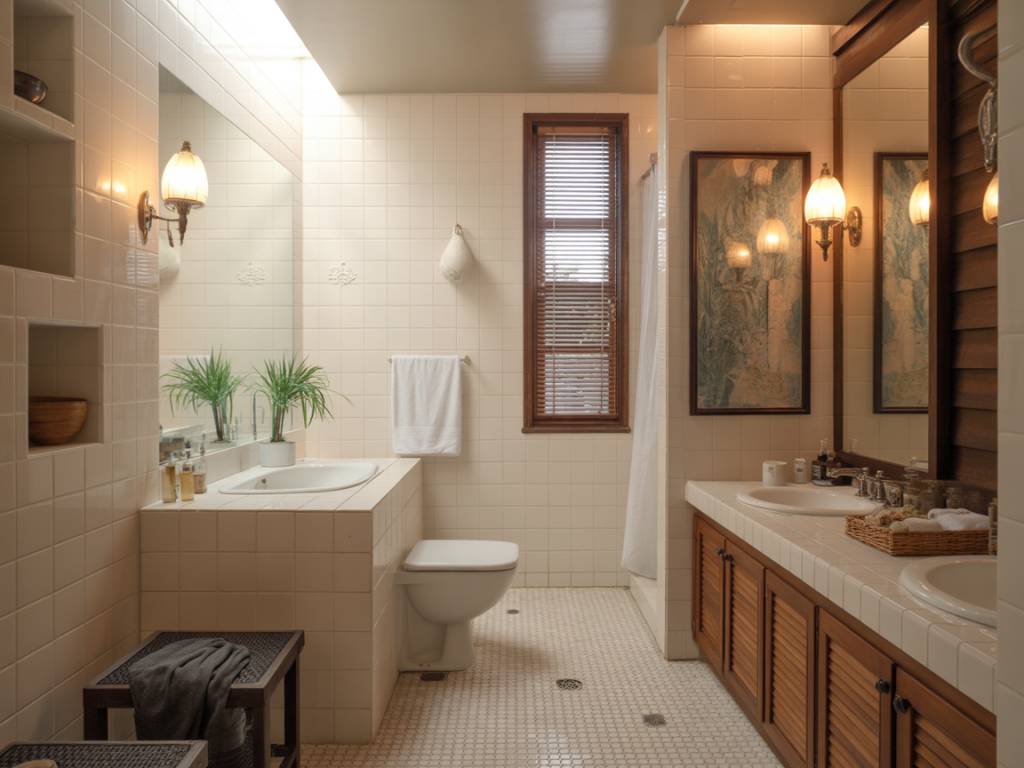
You don’t need a five-star hotel budget to get a spa-like bathroom. You need a clear plan, a few smart compromises, and the courage to ignore Instagram for a while.
In this guide, we’ll look at how to design a bathroom with a genuine spa feel on a realistic renovation budget. Not “if-money-were-no-object” realistic, but “I-have-a-number-in-Excel” realistic.
What does a “spa bathroom” really mean at home?
Let’s start by translating the fantasy into something constructible.
In practice, a spa-like bathroom is less about a freestanding tub in the middle of a 25 m² room and more about:
- Calm visuals: limited colour palette, clean lines, no visual chaos.
- Comfort rituals: good water pressure, a shower that doesn’t freeze or scald, enough hooks, warm towels.
- Soft, layered lighting: not brushing your teeth under a surgical spotlight.
- Warmth: thermal comfort, warm underfoot, no drafts.
- Materials that age correctement: no peeling joints and flaking paint in 2 years.
Keep this list in mind. It will guide every budget decision: if a choice doesn’t improve one of these points, it’s probably dispensable.
Step one: audit your existing bathroom (before dreaming)
Before choosing a terrazzo effect tile, you need to know what you’re working with. This is where you avoid budget landmines.
Check, room by room:
- Structure & layout: Are you in a flat with load-bearing walls you can’t move? Is the current layout functional or absurd (WC in front of the window, door hitting the basin, etc.)?
- Plumbing: Age of pipes, visible corrosion, recurring leaks, low pressure? Old steel or lead pipes often mean: plan for at least a partial replacement.
- Electricity: Presence of a proper earth connection? Enough circuits? No sockets too close to the shower? This is not a place to “see later”.
- Ventilation: Is there an extractor fan? Does it actually work? Any black spots on ceiling grout? Moisture kills the spa mood faster than anything.
- Envelope: Are walls straight? Floor level? Old plaster flaking? These affect tiling cost and choice.
Time & budget impact:
- Simple refresh (no layout change, no major plumbing/electrics): paint, fixtures, some tile work – typically the most budget-friendly.
- Medium renovation (update plumbing + electrics, same layout): more invasive but still controlled.
- Heavy renovation (move drains, enlarge room, structural work): spa-level budget required, not the focus here.
Be honest: if your bathroom has systemic issues (no proper waterproofing, dangerous electrics), allocate part of the budget to put the bones right. A beautiful shower column is useless over a leaking shower tray.
Define your priorities: where your money should go in a spa bathroom
With a realistic budget, you choose your battles. Here’s what I insist my clients prioritise when they aim for a spa vibe:
- Water experience: a good quality mixer, stable water temperature, sufficient pressure, and a shower that feels generous, even if it’s not huge.
- Lighting: ability to switch between functional (morning) and relaxing (evening) lighting.
- Warmth & acoustics: underfoot comfort, towel heating, and reduced echo (soft surfaces, textiles).
- Storage integration: hidden clutter = spa. Visible shampoo army = gym locker room.
- Low-maintenance surfaces: easy cleaning is part of the “relaxation” package.
Where can you save?
- Designer brands: mid-range mixers and tiles can look very high-end if correctly chosen.
- Ultra-complex layouts: niches, curved walls, and odd angles cost labour hours.
- Over-spec fixtures: you probably don’t need a steam shower with 9 side jets. A good overhead + hand shower is plenty.
Write your top 3 non-negotiables on paper (example: “quiet ventilation, warm floor, large shower head”). Refer to this every time a quote explodes.
Layout: make it feel generous, not just look pretty
Even in a small bathroom, you can create a spa-like sense of fluidity. The layout is more impactful than the tile pattern.
Questions to ask:
- Can I visually clear the floor? Wall-hung toilets and basins, and a shower without a clunky step instantly lighten the space.
- Where do I place the “hero” element? That might be a walk-in shower, a beautiful basin, or a niche with warm lighting. Put it in your direct line of sight when opening the door.
- Is the circulation logical? No squeezing sideways between the vanity and the shower. Aim for at least 60 cm clear passage in front of key elements.
- Could I combine bath + shower intelligently? If you must keep a bathtub, consider a straight, minimal glass screen and a wall-mounted mixer to avoid the “family bathroom” look.
Budget tip: Keeping WC and shower drains roughly where they are is a huge cost saver. If you want a “walk-in” look without redoing all plumbing, use a low-profile shower tray tiled similarly to the floor, rather than a fully recessed, custom shower base.
Materials: spa look without spa invoices
Here is where people often overspend. You can get 80% of the spa feel with good mid-range materials and thoughtful combinations.
Floors
- Porcelain stoneware tiles: durable, easy to clean, endless finishes. Look for:
- Soft, matte finish (anti-slip, visually calm).
- Warm greys, greige, sand tones rather than stark white.
- Large formats (60×60, 60×120) to reduce grout lines – check your installer is comfortable with it.
- Budget range (supply only):
- Entry-level: 20–30 €/m² – decent quality, simple finishes.
- Mid-range: 35–60 €/m² – better textures, more refined designs.
Walls
- Tile only where needed (wet zones: inside shower, around bath, behind basin if splashes). The rest can be painted with a suitable bathroom paint.
- Painted walls in a calm, warm neutral instantly reduce costs and visual noise.
- Feature wall in the shower: use a textured or vertical “fluted” effect tile on one wall only, keep others plain.
Worktops & furniture
- Laminate worktop with a good edge finish instead of stone can save hundreds. Choose matt, not glossy.
- Wood-look: if you want “warm wood spa”, consider high-quality wood-effect porcelain or moisture-resistant veneered furniture; avoid raw, unprotected wood in splash zones.
Realistic cost pointers (materials only, mid-range, per m² of bathroom):
- Floor + wall tile package (limited height): 500–1,000 € for a 4–5 m² bathroom.
- Paint (good bathroom paint, 2 coats): 80–150 € in materials.
- Vanity + basin + mirror: 400–1,000 € depending on width and finish.
The key: choose fewer different materials, but slightly better quality. One floor tile, one wall tile, one paint colour can already look very “spa hotel”.
Lighting: where a modest budget has huge impact
If you do one “design” thing in your bathroom, do this: plan your lighting in layers.
1. General lighting
- Ceiling downlights (IP rated for bathroom zones) or a flush ceiling fixture.
- Warm or neutral white (2700–3000K), not blue-ish. Spas never use cold lighting.
2. Mirror lighting
- Ideally vertical lights on both sides of the mirror, or a large backlit mirror. This is more flattering and practical than a single spot above.
- Avoid harsh spot directly overhead: it creates shadows on the face.
3. Ambient lighting
- LED strip in a shower niche, under vanity, or along a skirting for soft night lighting.
- Put ambient lighting on a separate switch or dimmer for “evening mode”.
Budget ranges (supply only):
- Ceiling fixtures / spots: 30–80 € each for decent quality.
- Backlit mirror: 120–300 € for standard sizes.
- LED strips (with proper IP rating + driver): 50–150 € depending on length and quality.
Don’t forget the electrician’s labour and compliance with local regulations. In a wet room, DIY electrical “tweaks” are not worth the risk.
Fixtures: where to splurge, where to save
Shower
- Spend on the mixer (thermostatic preferred) and shower head. You touch these every day.
- Save on overly complex systems. A simple set with:
- 1 overhead “rain” head (not necessarily huge).
- 1 hand shower on a rail.
- Good-quality hose and brackets.
Indicative budgets (supply only):
- Mid-range thermostatic shower kit: 200–600 €.
- Glass screen for walk-in shower: 200–600 € for a fixed panel, more if custom.
- Shower tray (slim, quality acrylic or resin): 200–500 €.
Basin & WC
- Wall-hung WC with concealed cistern looks lighter and is easier to clean around. Expect 300–800 € for pan + frame + plate (supply only).
- Basin: simplicity reads as “high-end” more than ornate shapes. A basic ceramic basin can look very spa with the right tap and worktop context.
Taps
- Choose one finish and stick with it: chrome or brushed nickel are budget-friendly and timeless.
- Black and brass are trendy but require better quality to age well (avoid very cheap coatings that peel).
- Mid-range basin mixer: 80–200 €.
Warmth, comfort and acoustics: invisible, but you feel it
Spa comfort is as much about temperature and sound as it is about aesthetics.
Heating
- Heated towel rail: functional and pleasant. Water-based is best if you have central heating; electric if not, or as a supplement.
- Electric towel rail: 200–500 € depending on design and power.
Floor comfort
- If you’re redoing the floor anyway, electric underfloor heating in the bathroom is often more accessible than people think:
- Material: ~50–100 €/m² for heating mat + thermostat.
- Labour: depends on existing floor and prep, plan with your tiler/electrician.
- If underfloor isn’t an option, invest in thick bath mats and avoid ice-cold colours on the floor.
Acoustics
- Soft textiles (curtains if you have a window, mats, bathrobes) reduce echo.
- Avoid full wall-to-wall hard glossy surfaces if possible; mix in painted walls and furniture fronts.
Ventilation
- Quiet, efficient extractor fan: look for a low decibel rating and humidity sensor if possible.
- Budget: 80–250 € for a good quality unit (supply only), plus electrician’s labour.
Storage and styling: the difference between spa and chaos
The most luxurious tile can’t fight against 15 shampoo bottles on the floor. Storage is a design element, not an afterthought.
Plan closed storage for:
- Everyday toiletries (per person).
- Cleaning products.
- Spare toilet paper, towels, hair tools.
Options that work well on a budget:
- Wall-hung vanity with drawers: drawers are more efficient than cupboards. You’ll use the entire depth.
- Recessed niches in the shower or near the bath: tiled niches feel more integrated than corner wire shelves. They cost more in labour (waterproofing + tiling) but visually, they’re very “spa”.
- Shallow wall cabinets above WC: great for storing bulkier items without eating into circulation.
Styling: keep it intentional
- Limit visible products to what you actually use daily. The rest lives in drawers.
- Use a small tray for a candle, a plant, and one nice bottle of hand soap or lotion – it creates a “ritual zone”.
- Choose two or three textile colours (towels, mats, bathrobe) that match or softly contrast your tile/paint. No rainbow.
Example budgets: what a “realistic spa upgrade” can look like
To give you an idea, here are two scenarios for a small to medium bathroom (4–6 m²). These are rough brackets, highly dependent on your region and existing state, but they help frame decisions.
Scenario 1 – Smart refresh, spa feel, minimal plumbing work
- Keep layout and existing drains.
- Replace shower fixtures, screen, vanity, mirror, lighting, wall paint; partial re-tiling in shower only.
Typical budget range (materials + labour): 5,000–9,000 €
- Tiles + paint + adhesive, grout, etc.: 1,000–1,800 €
- Fixtures (shower kit, screen, basin mixer, taps): 800–1,800 €
- Vanity + mirror + storage: 600–1,500 €
- Lighting + ventilation: 400–1,000 €
- Labour (tiler, plumber, electrician, painter): 2,000–3,500 €
Scenario 2 – Full renovation, same layout, real “spa at home”
- Strip-out, new tiles floor & walls, new fixtures, new electrics in room, lighting plan, underfloor heating, wall-hung WC and vanity.
Typical budget range (materials + labour): 10,000–18,000 € for 4–6 m²
- Tiles, paint, prep: 2,000–3,500 €
- Fixtures (shower system, WC, vanity, basin, taps): 2,000–4,000 €
- Heating (towel rail + possible underfloor): 600–1,500 €
- Lighting + ventilation: 600–1,500 €
- Labour (demolition, plumbing, tiling, electrics, painting): 4,000–7,500 €
These numbers are intentionally broad. The point is not to give you a quote, but to show that a spa feel is more about how you allocate the budget than how high it is.
Common pitfalls to avoid
A few classic traps I see on spa bathroom projects:
- Overspending on tile, underspending on labour: a 70 €/m² tile badly laid will always look cheap. If needed, downgrade the tile and upgrade the tiler.
- Ignoring ventilation: mould and condensation will silently destroy your “spa” in 6–12 months.
- Too many materials and colours: keep it simple. 1 floor tile + 1 wall tile + 1 paint + 2 textile colours is already a lot.
- No plan for storage: you will end up lining every surface with bottles and sponges. Design storage first, styling last.
- No contingency: old bathrooms hide surprises (rotten subfloors, dodgy pipes). Keep 10–15% of the budget aside.
Action checklist before you start
If you want this project to stay both “spa” and “realistic”, work through this list in order:
- Audit the existing bathroom: structure, plumbing, electrics, ventilation.
- Fix your overall budget and keep 10–15% in reserve.
- Define your top 3 priorities (comfort, ritual, and feel-based, not products-based).
- Decide if you keep the layout or not; if possible, keep drains where they are.
- Choose a simple material palette: 1–2 tiles, 1 paint, 1 tap finish.
- Plan storage volumes: drawers, niches, cupboards – before choosing pretty accessories.
- Design lighting in layers: general, mirror, ambient, on separate switches.
- Get at least two detailed quotes, line by line (labour + materials separated if possible).
- Check local norms and bathroom zoning rules for electricity and waterproofing.
Transforming your bathroom into a daily spa ritual is less about chasing trends and more about doing the basics exceptionally well: water, light, warmth, calm. If you structure your project around these four pillars, even a tight, realistic budget can deliver a bathroom that genuinely changes how your mornings and evenings feel.

