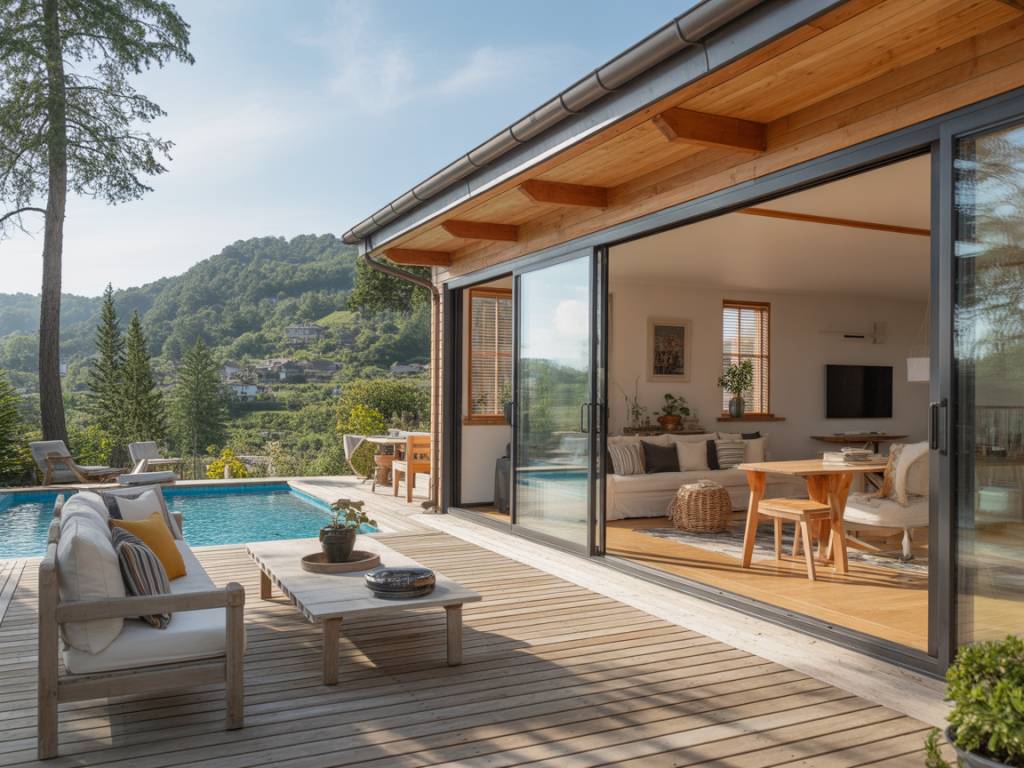
Creating an indoor outdoor flow with sliding glass walls
Why sliding glass walls change the way you live at home
Creating a real indoor–outdoor flow is not about having “a big opening on the garden”. It’s about making the boundary between interior and exterior disappear in daily life: when you cook, when kids play, when you have friends over, when you open the house on a spring morning without freezing the living room. Sliding glass walls are one of the most effective ways to achieve that.
Compared to a traditional French door or a single sliding door, a large glass wall:
Multiplies natural light deep inside the room
Visually agrandit (enlarges) the space without pushing any wall
Creates a direct extension of the living room towards a terrace or garden
Improves circulation during meals, parties and everyday comings and goings
Can increase the perceived value of the property when well designed
But it also means structure to modify, thermal insulation to control, water tightness to secure, and a serious budget. Let’s go step by step.
Does a sliding glass wall make sense in your home?
Before falling in love with Pinterest images, verify that the project is relevant to your existing space and lifestyle. Ask yourself:
Which room really needs this opening? Living room, kitchen, dining area, bedroom?
What is the direct outdoor extension? Tiny balcony, city patio, large garden, rooftop?
How many days per year will you realistically open the glass wall wide?
What is the orientation (north/south/east/west)? Risk of overheating or rather lack of light?
What is the current structure? Load-bearing wall, simple partition, existing opening to enlarge?
In practice, a sliding glass wall is most relevant when:
You have (or plan) a terrace or deck at the same level as the interior
The view is pleasant enough to be highlighted (no parking lot 2 m away)
The room is a main living space used daily (not a secondary guest room)
The wall to open is either non-bearing or can be reinforced without absurd cost
If you check at least three of these boxes, the project is worth exploring seriously.
Main types of sliding glass walls: choose the right system
“Sliding glass wall” covers several technical solutions. The choice has consequences on your budget, thermal comfort and ease of use.
1. Standard sliding doors on rails
2 to 4 panels sliding on a fixed bottom rail
One or two panels are active, the others remain fixed
Most common and generally the most affordable
Good for openings up to +/- 4–5 m wide
2. Lift-and-slide systems
The handle “lifts” the panel slightly to make sliding easier
Better air and water tightness when closed
Allows large and heavy panels (less vertical profiles, more glass)
More expensive than standard sliders but very comfortable to use
3. Sliding pocket walls (disappearing into the wall)
The panels slide into a dedicated cavity in the adjacent wall
When fully open, the opening is completely free (no stacked panels)
Requires sufficient wall thickness and specific preparation
Great aesthetic effect, but more complex and expensive work
4. Sliding + fixed glass combination
Part of the wall is fixed glazing (for example, upper section or side bay)
Useful when you want a very high glass frame but a standard-height sliding portion
Allows to play with asymmetrical compositions
In most renovations, a lift-and-slide system on 2 or 3 rails (to stack panels on one side) offers the best compromise: large opening, good insulation, comfortable handling.
Key technical choices: glass, frame, thresholds and comfort
Once the general system is chosen, you need to go into the details that will make the difference on a daily basis.
Glazing
Double glazing with low-emissivity coating is standard today in most climates
Triple glazing can be relevant in cold regions, but panels are heavier and some systems are not compatible
Ask for a glass with a solar factor adapted to your orientation: protect yourself on a full south with large bay, capture heat on an east or west exposure with less risk of overheating
Consider acoustic laminated glazing if you are in an urban or noisy environment
Frames
Aluminium: slim profiles, very stable over time, ideal for contemporary aesthetics; pay attention to thermal break quality
Wood: warm look, excellent insulation, but requires regular maintenance outdoors
Aluminium-wood hybrid: alu outside, wood inside, best of both worlds… and of both price ranges
PVC: often cheaper, correct performance, but thicker profiles and sometimes less elegant aesthetic on large dimensions
Thresholds and accessibility
Opt for a low or flush threshold, especially if you are creating continuity with a terrace or deck
Verify compliance with regulations on accessibility and step heights in your country
Plan the water drainage: a flush threshold without a drainage solution is an invitation to infiltration
Thermal and solar comfort
Anticipate summer overheating: external blinds, pergola, brise-soleil, wide overhang, trees
Plan ventilation scenarios: sliding + oscillating windows in another area to create air flow
Check the Uw (window) and Sw (solar factor) values with your supplier and compare, not just the price
Structure, permits and feasibility: do not skip this step
Opening a façade is never “just cutting a bigger hole”. Even in a small house, the wall you want to open may carry part of the upper floor or roof. Before thinking about colours of frames, you need to secure the structure and the legal part.
Structure
Identify whether the wall is load-bearing (masonry, concrete, structural timber) or a simple partition
If load-bearing: you will most likely need a structural engineer to calculate the beam to install above the opening
Plan temporary shoring during the works and a clear phasing (this is not a DIY weekend if you touch structure)
Permits and regulations
In many countries, enlarging an opening on façade modifies the exterior appearance and may require a permit or declaration
In co-ownership (apartments), any change on façade usually needs a vote at the general assembly
Check possible constraints: protected zone, colour of joinery imposed, alignment rules, etc.
Do this check before signing for the joinery. It avoids having three custom panels sleeping in a garage because the city refused the project or required a different layout.
Budget: what to expect for a sliding glass wall
Costs vary widely depending on country, brand, dimensions and finishing level, but you can work with the following orders of magnitude (material + installation, excluding heavy structural works):
3–4 m wide, standard sliding alu double glazing: approx. 4,000–7,000 €
3–4 m wide, lift-and-slide high-performance alu: approx. 6,000–10,000 €
5–6 m wide large opening, lift-and-slide with minimal frames: often 10,000–18,000 €
Exterior works (deck, terrace, drainage, steps): very variable, from 2,000 € for a simple wooden deck to 15,000 €+ for a big terrace
In renovation, a realistic global budget for “creating an indoor-outdoor flow with a large sliding glass wall” is often between 10,000 and 30,000 €, all trades included. This is a large range, yes. That’s why you need detailed quotations by item:
In summer, the two active panels slide to create a 2.4 m fully open space: living room feels like 40 m² instead of 28 m²
In mid-season, the glass brings extra solar gain end of the day, with blinds to avoid glare
The deck, used previously maybe 10 days per year, becomes a second “living room” from April to October
Is it a big investment? Yes. But in terms of usage of the house, the transformation is radical: the garden is no longer “outside”, it becomes an extension of the living space.
Common mistakes to avoid
On this type of project, the same errors repeat themselves. Anticipating them will save you money and frustration.
Underestimating solar protection and ending with a living room at 30°C in summer because you relied only on the double glazing
Neglecting drainage at a flush threshold: the first big storm will remind you of it
Choosing the cheapest system with stiff or fragile sliding: opening your glass wall should not be a gym session
Forgetting the link with the exterior layout: a beautiful glass wall that opens onto a 30 cm step and uneven ground will be used less
Not coordinating trades: the joiner arrives, the opening is not ready, the terrace levels are not defined… delays and extra costs guaranteed
Maintenance and long-term use
A sliding glass wall is a long-term investment. To keep it fluid and efficient you will need minimal but regular maintenance.
Clean rails and drainage holes at least twice a year to avoid blockages
Lubricate moving parts with products recommended by the manufacturer (never improvise with random grease)
Check seals and joints every 2–3 years, especially on exposed façades
Wash glass with appropriate tools: large panels mean visible streaks if cleaning is rushed
Have adjustments checked after the first year if you notice rubbing or harder sliding (house settling, minor deformation)
A well-chosen and well-installed sliding glass wall can easily last 25–30 years. The difference between a joy and a permanent frustration is played out during design and installation, not in the catalogue.
If your objective is really to blur the line between interior and exterior, think of the project as a whole: structure, glass, terrace, shading, circulation. The sliding wall is the keystone, but it only works perfectly when the rest of the house and garden follow.