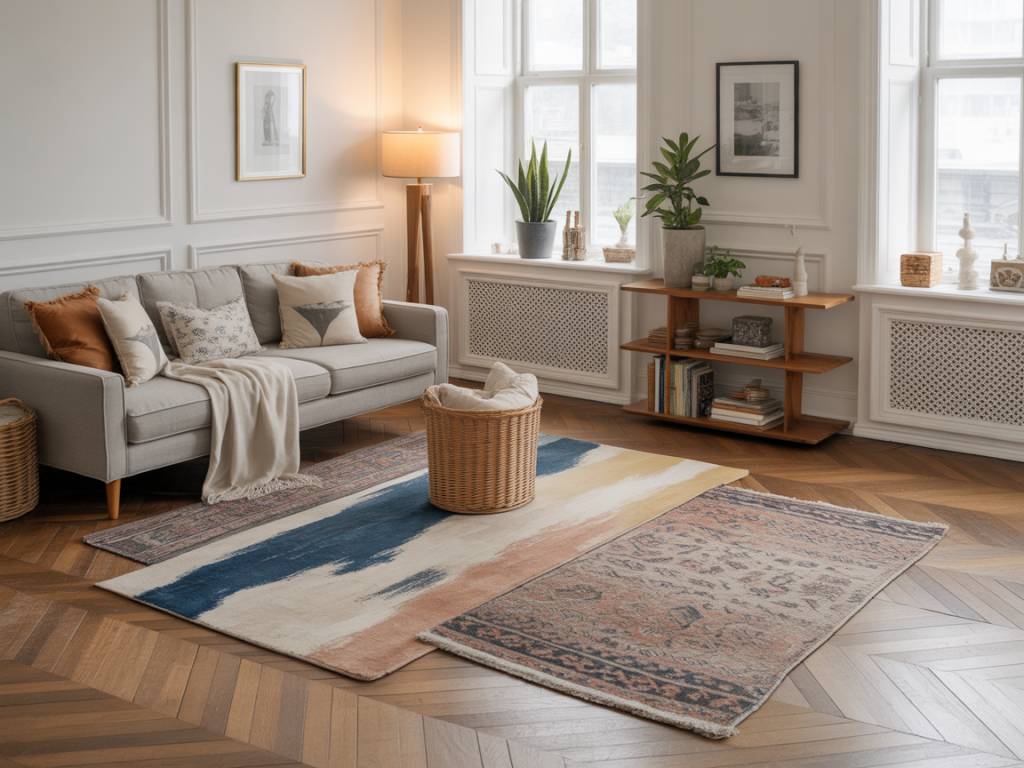
Layering rugs is one of those design tricks that looks très “stylé Pinterest”… and pourtant, quand on le tente chez soi, on se retrouve vite avec un tapis qui gondole, un coin qui rebique et une impression de bazar visuel. La bonne nouvelle : avec un peu de méthode (et quelques règles de proportions), c’est beaucoup plus simple qu’il n’y paraît.
Objectif : obtenir un rendu à la fois chaleureux et moderne, c’est-à-dire cosy sans tomber dans le boho fouillis. Ici, on va parler tailles, matériaux, combinaisons qui fonctionnent à tous les coups, budget, entretien… et surtout, comment tester avant d’acheter.
Why layering rugs works (when it’s done right)
Layering rugs isn’t just a trend. Used intelligemment, it helps you:
- Warm up a cold or echoey room (parquet, carrelage, béton ciré).
- Define zones in an open-plan layout without adding furniture.
- Add character when the architecture is simple or minimal.
- Correct proportions if your main rug is a bit too small.
- Play with style (contemporary base, more “crafted” rug on top).
In contemporary interiors, layering works especially well because you keep the envelope simple (sols, murs, menuiseries) and you “load” the texture and warmth at floor level. It’s a controlled way of adding personality.
Start with the base: choosing your bottom rug
Think of the bottom rug as your “canvas”. It sets the scale and calms everything else down. 80% of the modern-cozy effect depends on this choice.
What works best as a base rug?
- Natural flat-weave: jute, sisal, seagrass, or a flat wool blend.
- Neutral tones: beige, greige, sand, light grey, camel.
- Simple texture: subtle weave, very low contrast pattern.
Recommended sizes (living room):
- Small room (up to 15 m²): base rug 160×230 cm minimum.
- Medium room (15–25 m²): base rug 200×300 cm.
- Large room (25 m²+): base rug 250×350 cm or larger.
Rule of thumb: your base rug should visually “hold” your main seating area. Ideally, front legs of sofa and armchairs on top. Then, your smaller layered rug comes above, under the coffee table or décentré.
Budget ranges (for the base):
- Entry-level jute 160×230 cm: around 80–150 €.
- Good quality jute/sisal 200×300 cm: 200–400 €.
- Flat wool 200×300 cm: 400–900 € (depending on brand and thickness).
If you must save money somewhere, economise on pattern, not on size. A large simple rug + a smaller character piece on top will always look more high-end than two small rugs floating au milieu du salon.
Then the star: choosing your top rug
The top rug is where you add personality: colour, pattern, texture, history. It should be visibly smaller than the base rug, and more “concentrated” in character.
Ideal size ratios:
- Top rug about 60–70% of the length and width of the base rug.
- Visually, you want to see a generous “border” of the bottom rug all around the top rug (15–30 cm at least).
What types of top rugs work well?
- Vintage or Persian-style rugs: to warm up a very minimal room.
- Beni Ouarain / Berber-style rugs: thick, fluffy, graphic but still soft.
- Tufted or high-pile wool: for a cosy, tactile effect.
- Bold patterned kilims: if your base rug is very calm and your furniture simple.
Budget idea for the top rug (smaller sizes like 140×200 or 160×230):
- Machine-made, patterned: 80–300 €.
- Handmade wool or vintage: 300–1000 €+.
If you have a beautiful but too-small rug that currently “floats” in your living room, layering is your solution: buy a large, neutral base rug underneath and reuse your favourite piece as the top rug. C’est exactement ce qu’on fait sur beaucoup de projets de rénovation pour réintégrer un tapis déjà existant.
Three foolproof layering formulas
To avoid se perdre dans les combinaisons, voici trois recettes qui fonctionnent quasiment à tous les coups dans un intérieur contemporain.
Formula 1: Jute base + soft wool rug
- Base: large jute or sisal, natural colour.
- Top: fluffy wool rug (Beni Ouarain style, off-white with dark lines).
- Effect: very warm and tactile, but still graphic and modern.
- Where: living room, bedroom under the bed, reading corner.
Formula 2: Neutral flat-weave + patterned kilim
- Base: flat, plain rug (grey or greige).
- Top: colourful kilim or patterned rug, rather low-pile.
- Effect: adds “character” and a travel vibe without overwhelming.
- Where: living room, home office, under a dining table (attention aux chaises).
Formula 3: Large plain rug + accent runner
- Base: large plain rug following the shape of the room.
- Top: long runner placed off-centre or partially under a piece of furniture.
- Effect: dynamic, slightly unexpected, très contemporain.
- Where: long living rooms, bedrooms, corridors opening into a larger space.
Step-by-step: how to layer your rugs without guesswork
Before you click “order now”, take 30 minutes pour passer à la méthode.
Step 1 – Define the zone you want to anchor
- Living room: sofa + coffee table + armchairs.
- Bedroom: bed + bedside tables + maybe a bench.
- Dining: table + chairs, with enough room to pull the chairs back.
- Circulation: entry zone, reading corner, home office area in an open space.
Measure the area you want to “draw” with your rugs. Note the minimum and maximum you can afford in terms of dimensions (watch out for door openings and radiators).
Step 2 – Check your furniture layout
Ask yourself:
- Which furniture legs must be on the rug for the layout to feel stable?
- Where will people walk? Avoid a rug edge exactly in a circulation line.
- Any doors that open over the rug? Check the thickness.
Sketch it quickly (même à main levée) with approximate dimensions. This alone évite 80% des achats ratés.
Step 3 – Choose the base rug first
Target: the largest size that fits comfortably in your space without touching all the walls. Leave at least 10–20 cm of visible floor between rug and walls.
Select 2–3 options max in a neutral tone and texture. Compare:
- Fibre (jute, sisal, wool, synthetic).
- Thickness (under doors and chairs).
- Maintenance (stains, pets, allergies).
Step 4 – Then look for the top rug
Now, base rug dimensions are decided. Your top rug should be smaller by 40–80 cm in each direction. Use painter’s tape or cartons on your base rug (or directly on the floor) to simulate the future top rug and adjust before buying.
Check:
- Contrast: one of the two should be calm. If the top rug is busy, keep the base very quiet.
- Colour links: pick at least one colour of the top rug that exists ailleurs dans la pièce (coussin, rideau, tableau).
- Texture balance: avoid two very scratchy or two super fluffy rugs together.
Step 5 – Test the placement
When your rugs arrive:
- Lay the base rug first and centre it par rapport au mobilier, not the walls.
- Add the top rug and experiment:
- Perfectly centred under the coffee table.
- Slightly offset, aligned with the sofa.
- Diagonal? Possible, but be cautious: modern interiors rarely need diagonals.
Take photos from the main view angles (entrée du salon, assis sur le canapé, etc.). On photos, les erreurs de proportions sautent aux yeux. Adjust before cutting the labels.
Room-by-room layering tips
Living room
- Base rug: large enough so that at least the front feet of the sofa and armchairs sit on it.
- Top rug: under the coffee table or slightly décalé towards the main sofa.
- Be careful with rocking chairs or unstable legs on the junction between two rugs.
- If you have a corner sofa, let the base rug follow its L-shape, and position the top rug in the “centre” of the L for balance.
Bedroom
- Option 1: large base rug under the bed (extends at least 60–80 cm on each side and at the foot).
- Top rug placed partially under the bed, décalé on one side or at the foot.
- Option 2: base rug centred under the bed + two smaller runners layered on each side.
- Avoid tiny rugs “postage stamp” on each side of the bed: layering won’t save proportions if everything is too small.
Dining area
C’est la pièce la plus délicate pour le layering.
- Base rug: big enough so that chairs stay fully on the rug even when pulled back (add at least 60–70 cm around the table).
- Top rug: only if your table is fixed or huge; otherwise, the extra edges become pièges for chairs.
- If your dining space is in a large open-plan room, consider:
- One large, plain rug for the dining zone.
- Layering only in the living zone next to it to avoid visual overload.
Hallway / Entry
- Base rug: runner that follows the length, in a resistant material.
- Top rug: small accent rug near the door or at the junction with the living area.
- Watch door clearances carefully: here, thin flat-weaves are your friends.
Materials, comfort and maintenance
Layering doubles the textiles au sol, so you need to think pratiquement: cleaning, allergies, pets, kids.
Good combos for everyday life:
- Base: jute or sisal (hardwearing) + Top: wool (easy to clean, naturally anti-static).
- Base: synthetic flat rug (for stains) + Top: wool or cotton washable rug.
- Base: low-pile wool + Top: removable, machine-washable rug in kids’ areas.
Less ideal combos (to handle with caution):
- Two thick high-pile rugs layered: trip hazards + hard to vacuum.
- Two very light rugs on a slippery floor: they will slide, even with rug pads.
- Very textured base (big knots) + delicate vintage top: friction can damage the underside.
Time and care to plan:
- Vacuuming: count on an extra 5–10 minutes per session with layered rugs (edges and overlaps to manage).
- Rotation: every 6 months, rotate both rugs by 180° to even out wear and sun exposure.
- Spot cleaning: always test on a small, hidden part first; fibres réagissent différemment.
Safety and practicality: don’t skip this part
On chantier, on voit très vite ce qui fonctionne visuellement, mais aussi ce qui est dangereux au quotidien. Layering = plus d’épaisseurs = risques de chute si mal maîtrisé.
To-do list sécurité:
- Use non-slip rug pads under the base rug, especially on wood or tiles.
- Fix the top rug with rug tape at the corners and mid-sides if it tends to move.
- Check all rug edges in circulation zones: nobody should catch a toe or a chair leg on a border.
- In homes with elderly people or toddlers, prefer low-pile rugs and minimise overlaps in paths.
Plan 30 minutes on the day you install your rugs just for adjustments: couper la sous-couche, déplacer légèrement le mobilier, coller les angles. C’est du temps gagné sur les années suivantes.
Common mistakes to avoid (and how to fix them)
Rugs too small
- Symptom: the whole seating area “floats” around a tiny patch under the coffee table.
- Fix: buy a large, affordable base rug and keep your small rug as the top layer. Instantly more “architectural”.
Too many patterns
- Symptom: busy curtains + patterned sofa + patterned cushions + two very graphic rugs.
- Fix: calm the base rug (plain, neutral) and choose a top rug that picks up only one of the existing patterns or colours, not all of them.
Wrong colour temperature
- Symptom: cold grey floor + jute rug + very cold blue-grey top rug → atmosphere feels froid, almost hospital-like.
- Fix: bring in at least one warmer tone (camel, terracotta, warm beige) in one of the two rugs to rebalance.
Edges in the wrong place
- Symptom: rug junction exactly under the front chair legs, creating instability.
- Fix: move the top rug fully under the furniture piece or fully outside its footprint. Avoid half-on, half-off on small legs.
How much should you budget for a layered rug look?
You don’t need a 2000 € tapis persan to get a chic layering effect. You do need coherent proportions and decent quality on at least one of the two rugs.
Entry-level scenario (small to medium living room):
- Base jute 160×230 cm: ~100–150 €.
- Top machine-made patterned rug 120×170 cm: ~80–150 €.
- Total: 180–300 € for a first layering, correct if you choose well.
Mid-range scenario:
- Base wool flat-weave 200×300 cm: 350–600 €.
- Top wool or Beni-style rug 160×230 cm: 300–700 €.
- Total: 650–1300 € for a durable, comfortable combo.
High-end scenario:
- Base custom-sized wool or sisal 250×350 cm: 800–1500 €.
- Top hand-knotted or vintage rug: 800–2500 €+.
- Total: 1600–4000 €+, usually in projects where rugs are treated as long-term investments.
Si votre budget est serré, je préfère voir un bon grand rug abordable en base + un top rug trouvé en seconde main ou en outlet, plutôt que deux pièces cheap qui vieillissent mal.
Before you buy: a 10-minute checklist
Pour finir, faites ce mini-audit chez vous avant de sortir la carte bleue.
- Have you mesured your furniture layout (not just the room)?
- Do you know the maximum rug thickness for doors to clear?
- Have you identified the main colour palette of the room (3–5 colours max)?
- Do you have at least one neutral, calm rug in the duo?
- Have you planned a non-slip pad or rug tape in the budget?
- Is the high-maintenance rug (light, fluffy, delicate) placed where it will be least exposed to stains?
- Have you checked care instructions for both rugs (dry-clean only, washable, etc.)?
- Can you easily move or lift the rugs to clean under them (important in small apartments or with pets)?
Layering rugs, done thoughtfully, is one of the most efficient ways to make a contemporary space feel lived-in, warm and intentional. Treat your rugs like you treat your furniture plan: with measurements, tests and a bit of discipline. The “cozy yet modern” look doesn’t come from buying more décor, but from a few well-chosen layers that work together instead of competing.