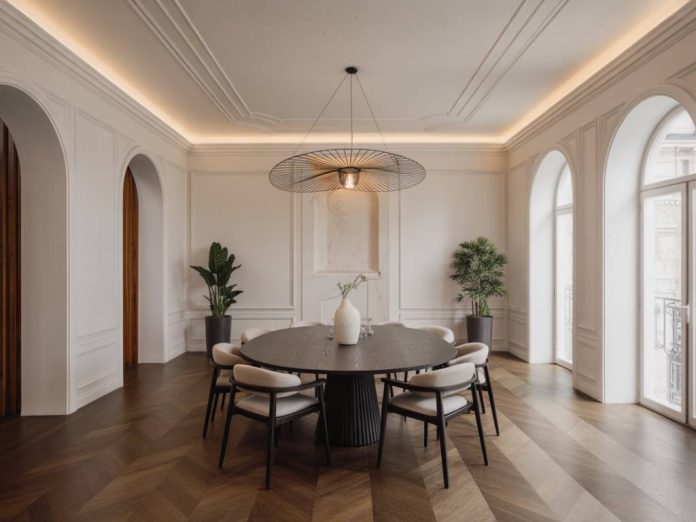
Statement lighting in a contemporary dining room is not just about hanging “a nice pendant” above the table. It is your main architectural gesture in a space that, la plupart du temps, n’a pas beaucoup d’éléments forts : une table, quelques chaises, parfois un buffet… et c’est tout. Le luminaire devient alors le vrai centre de gravité de la pièce.
In this article, we’ll look at statement lighting ideas that stay practical: heights that work in real life, budgets that don’t explode, materials that age well, and a few traps to avoid so you don’t end up with a beautiful but unusable sculpture of light.
Start with the role of your dining room lighting
Before scrolling endlessly through design lamps, start with a simple question: what do you actually do in this room?
If your dining room is used for:
- Daily meals + homework + laptop work: you’ll need flexible lighting, dimmable, with comfortable brightness and no glare.
- Occasional dinners and large gatherings: you can push the sculptural side and rely on candles or accent lights for atmosphere.
- Open-plan living (kitchen–living–dining): your dining light becomes a visual anchor, helping to structure the space more than to “light everything”.
From there, define three things:
- Light level: do you want bright functional light or mostly mood lighting?
- Light direction: direct on the table, diffused in the room, or both?
- Control: simple on/off, or dimmer and maybe smart controls?
Once this is clear, choosing a statement fixture becomes much easier: you’re not just shopping for a shape, but for a tool.
Oversized pendants: the easiest way to make a statement
If you only remember one rule: a dining light is almost always better slightly too big than slightly too small.
For a contemporary look, an oversized pendant works particularly well above a rectangular or oval table.
Rough sizing rule (for one central pendant):
- Diameter of the pendant ≈ ½ to ⅔ of the table width.
- For a 90 cm wide table, aim for a 45–60 cm diameter pendant.
- For a 100–110 cm wide table, 50–70 cm usually looks right.
Suspension height (most common mistake):
- Bottom of the pendant at about 75–85 cm above the table.
- Or 150–165 cm from the floor for a standard table height.
- In a very high ceiling (3 m+), resist the temptation to hang it too high: you want the light in conversation level, not floating near the ceiling.
Materials that age well in a contemporary dining room:
- Matte metal (black, white, bronze) for a clean, graphic line.
- Opal glass for soft, flattering light (great for faces, less great if you want ultra-bright).
- Textile shades if you’re ready to dust them regularly and avoid greasy air from an open kitchen.
Budget reference (single oversized pendant):
- Entry-level design brands: 150–400 €.
- Mid-range / good European brands: 400–1 000 €.
- Iconic designer pieces: 1 000–3 000 € and more.
- Electrician installation (existing ceiling point): usually 80–200 €.
Point de vigilance : check glare. In the showroom, you stand and look at the lamp from below; at home, you’ll be seated with the bulbs at eye level. Prefer diffusers, opal shades or integrated LED with a proper shield.
Linear suspensions for long rectangular tables
For a long rectangular table (200 cm+), a linear suspension is often more efficient than a big round pendant that leaves the ends in semi-darkness.
Two main families:
- Minimalist LED bars: a thin line of light, very contemporary, almost architectural.
- Multi-point bars: several small shades or bulbs aligned along a bar.
When it works best:
- Rectangular tables of 180–280 cm.
- Ceiling height of at least 2.50 m to keep a good sense of volume.
- Open-plan arrangements where the linear light can also structure the circulation.
Practical tips:
- Length of the fixture ≈ ½ to ¾ of the table length.
- Center it on the table, not on the room, especially if the table is slightly offset in an open space.
- Add a dimmer: most linear suspensions are quite powerful; without dimming, you’ll feel like you’re in a meeting room.
Budget reference (linear suspension):
- Minimalist LED bars: 250–800 €.
- Architectural brands with high-end finish: 800–2 000 €+.
Point de vigilance : check if the LED module is replaceable. A beautiful bar glued with non-replaceable LED may end up in the bin in 8–10 years. Some brands sell replaceable modules; ask before you buy.
Clusters and multi-pendants for round tables
Round table? You can either go for a single oversized pendant, or play with clusters (3, 5, sometimes more small pendants hung together).
This is very effective for:
- Bringing vertical rhythm in a high ceiling room.
- Creating a sculptural composition while keeping small individual fixtures.
- Combining glass, metal and color without overwhelming the room.
How to avoid the “chaotic” effect:
- Choose a common thread: same glass color, same metal finish, or same geometric family.
- Vary heights by 10–20 cm, not 50. You want a group, not a waterfall in a hotel lobby.
- Rough diameter of the whole cluster ≈ ½ to ⅔ of table diameter.
Installation options:
- Preconfigured clusters sold as one product: easier, usually one single power outlet.
- Custom cluster: several single pendants grouped on a multi-outlet ceiling rose. More flexible but requires a careful plan and a good electrician.
Budget reference (cluster above a round table):
- Preconfigured glass cluster: 350–1 200 € depending on brand and number of lights.
- Custom: 100–300 € per pendant + 100–250 € for the canopy + electrician.
Point de vigilance : weight. When you start clustering 5–7 glass pendants, total weight can exceed the capacity of a basic ceiling hook in old plaster. Your electrician may need to add a proper fixing to the concrete slab or a dedicated wooden plate above the ceiling.
Sculptural chandeliers: when the light is also art
If you want your dining room to have a real “wow” moment, a sculptural chandelier is hard to beat. Think:
- Organic LED branches.
- Asymmetrical mobile-like fixtures.
- Graphic rings or halos.
They are perfect if:
- You have a high ceiling (2.80 m and above).
- The dining room is visible from the entrance or living area: the fitting becomes a visual landmark.
- You’re okay with your lighting budget taking a central share of the room budget.
Practical checklist before falling in love with a sculptural piece:
- Can the height be adjusted on site, or is it fixed at the factory?
- What is the minimum height possible? (Important with beams or low areas.)
- Is it dimmable with standard wall dimmers, or do you need a specific system?
- Maintenance: how do you dust it, and are replacement parts available?
Budget reference (sculptural chandeliers):
- Design brands entry level: around 700–1 500 €.
- Recognized designer pieces: often 1 500–5 000 € and much more for custom work.
- Installation can be more complex (multiple cables, balancing): plan 150–400 €.
My experience from renovation projects: if you go sculptural, plan it early with your electrician. Many of these chandeliers require multiple fixing points, hidden drivers, or reinforced supports. Improvising this at the end of the project is almost always a bad idea.
Layered lighting: don’t rely only on the pendant
Even the most spectacular pendant will not cover all uses of a dining room. For a really comfortable, contemporary space, add at least one or two of these layers:
- Wall lights on dimmer: perfect to light the room without blasting the table, and to give depth to the walls.
- Floor lamp near a sideboard or in a corner: moves easily if you reorganise the space, softens shadows.
- LED strip under or above a sideboard: subtle glow that frames the dining area, especially in open-plan layouts.
- Ceiling spots (if you’re renovating the whole room): on a separate circuit so you can have “service light” for big clean-ups or buffets.
Quick wiring tip if you’re in renovation phase: ask for at least two independent circuits in the dining room (for example: pendant + wall lights), both dimmable. The cost difference compared to a single on/off is marginal at the wiring stage, and the comfort gain is huge.
Technical essentials: color temperature, dimming and glare
Some technical choices completely change the atmosphere of your dining room, even with the same fixture.
Color temperature (Kelvin):
- 2700 K: warm, cosy, like traditional bulbs. Best choice if your dining room is mainly for evenings and you want a relaxed, intimate mood.
- 3000 K: still warm but slightly fresher, more “hotel contemporary”. Works well in open-plan spaces where you don’t want the dining area to feel too yellow compared to the kitchen.
- Avoid 4000 K and above in a dining room unless you are deliberately going for a very “office / gallery” feel.
Dimming:
- Always aim for a dimmable solution for the main pendant or chandelier.
- Check compatibility between the driver (for LED) and your wall dimmer (Triac, DALI, etc.). If this sounds like jargon, ask the retailer to sell you a compatible dimmer, or have your electrician check the datasheet.
Glare:
- Avoid exposed, ultra-bright LED filaments right in your line of sight when seated.
- Prefer shaded, frosted, or indirect light for dining areas.
- If you love bare bulbs for the design, pick low-wattage, warm, dimmable models and test them in the evening before committing.
Materials and finishes that create a strong visual presence
In a contemporary dining room, the statement effect often comes from a simple silhouette + strong material, rather than from heavy ornament.
Safe bets that work with many interior styles:
- Black matte metal: draws a clear line in space, great contrast on white or light grey ceilings.
- Brushed brass: warms up minimalist interiors, works very well with wood and terrazzo.
- Opal or smoked glass: softens the light, adds a subtle reflective quality without shouting.
- Textured shades (pleated fabric, ribbed glass): bring depth and sophistication without being flashy.
When to go bold:
- If the rest of the room is very calm (neutral walls, simple furniture), you can afford a colored or highly sculptural piece.
- If you have a large, simple white box room, a bold chandelier can prevent the space from feeling sterile.
When to stay quiet:
- If you already have a very strong material palette (marble veining, colored wall, patterned rug), choose a more restrained fixture and let forms and light speak rather than color.
- If the dining room is visually connected to several other statement elements (staircase, large artwork), your light should coordinate rather than compete.
Budget scenarios: where to invest, where to save
In real renovation projects, budgets are not unlimited. Here is how I usually advise clients to allocate money for dining lighting.
Scenario 1: Tight budget (around 300–600 € for the whole dining area)
- Choose a simple but oversized pendant from a good value brand (150–300 €).
- Add 1–2 affordable wall lights (50–100 € each).
- Invest in a decent dimmer and warm LED bulbs (50–100 €).
- DIY installation if you’re comfortable and regulations allow, otherwise plan 100–150 € for an electrician.
Scenario 2: Balanced budget (600–1 500 €)
- Pick a mid-range design fixture with strong character (400–800 €).
- Layer with a floor lamp and a couple of wall lights (200–400 €).
- Install two circuits with dimmers (material and electrician together may run 200–300 €).
Scenario 3: Investment piece (1 500–4 000 €+)
- Choose a sculptural chandelier or a designer cluster as the main investment (1 200–3 000 €).
- Support it with discreet but quality architectural lights (wall lights, spots, LED strips) for another 400–800 €.
- Plan a proper lighting scheme with your architect or designer to avoid technical surprises.
In every scenario, I recommend not compromising on:
- Dimming ability.
- Color temperature consistency (all sources in the same range).
- Basic safety and installation quality (equally important in a 200 € and 2 000 € lamp).
Installation, planning and common mistakes
A few recurring problems I see on renovation projects, and how to avoid them.
- Fixture not centered on the table: very common when the electrical point was placed before the final furniture layout. If you can’t move the wiring in the ceiling, use a decentralised canopy with a long cable to bring the pendant above the table.
- Suspension hung too high: every time. Take the time to test with the real table (or at least with tape on the floor) before cutting cables. Sit down, stand up, walk around. Adjust, then cut.
- No dimmer: a big pendant at full power over a dinner is aggressive. In an existing room, you can sometimes replace the wall switch with a compatible dimmer without redoing the whole wiring; talk to your electrician.
- Bulbs chosen at the last minute: you’ve invested in the fixture, don’t kill it with cheap, too-cold, non-dimmable bulbs. Decide Kelvin, lumen and dimming upfront.
- Ignoring the view from other rooms: in open-plan living, your dining light is visible from the sofa, the kitchen, sometimes even the entrance. Check how its scale and alignment work from these points too.
Time-wise, for a straightforward replacement (existing ceiling point, no change in wiring), count:
- 1–2 hours for a simple pendant.
- 2–4 hours for a complex chandelier or custom cluster.
For a full renovation with new circuits, plan your lighting scheme before plasterboard and painting. Moving a junction box after the ceiling is finished costs far more than taking one extra hour at the plan stage.
In the end, a contemporary dining room with statement lighting is less about chasing the latest Instagram trend and more about orchestrating light around your table: the piece you choose, its scale, the way it hangs in space, the quality of the light it provides, and how it interacts with the rest of the room.
Ask yourself: how do you want people to feel when they sit at your table? Then design your lighting to serve that feeling — and only then, pick the shape that will make you smile every evening when you switch it on.